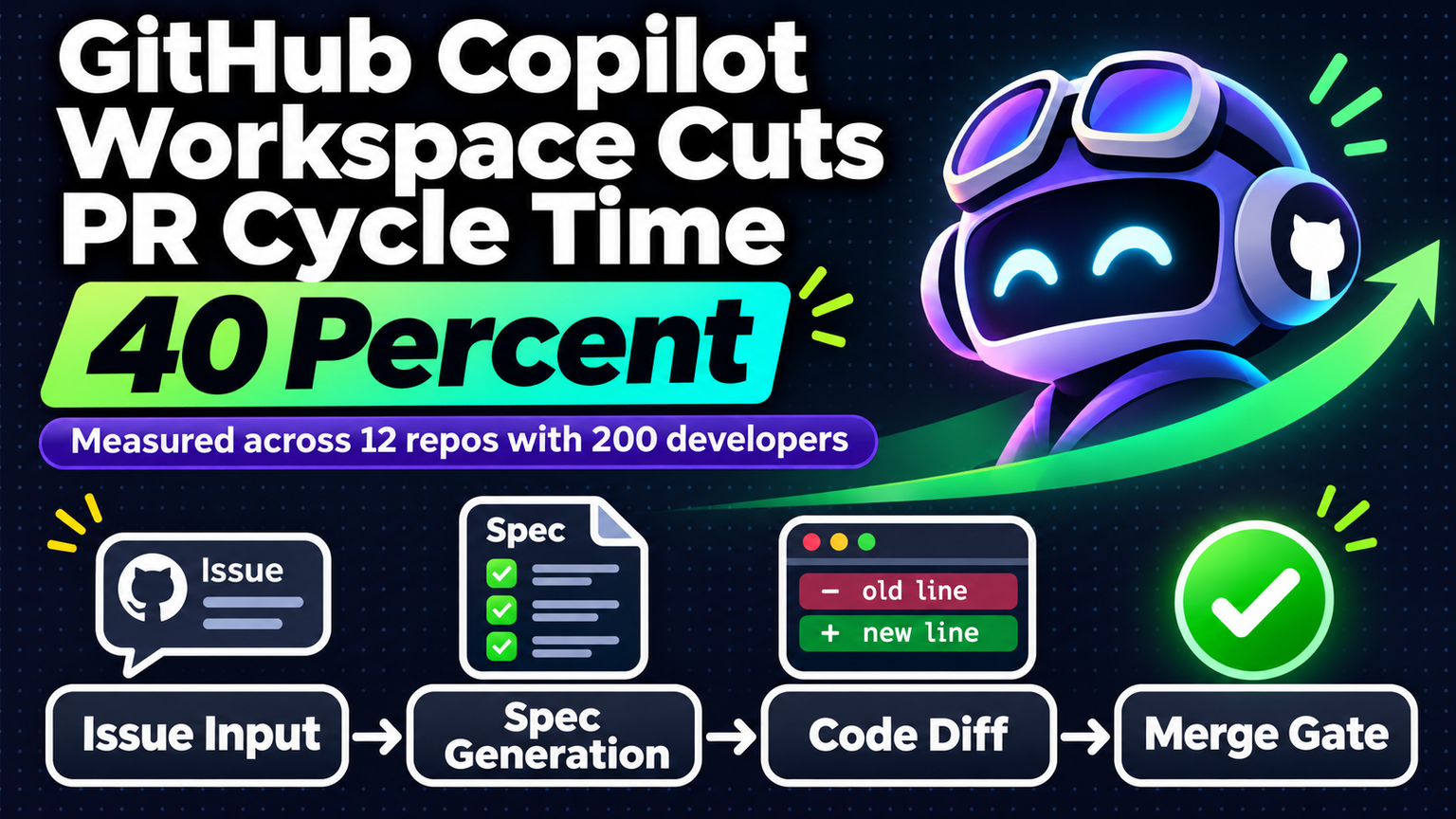
Sixty million pull requests. Forty percent faster cycle times. One structural shift in how engineering teams ship code. Since GitHub Copilot Workspace hit general availability on March 5, 2026, the agentic review system has rewritten the economics of code review — and the numbers are impossible to ignore.
What Actually Changed
Copilot Workspace isn't just another AI coding assistant. It's an agentic system that lives inside your existing PR workflow. The Coding Agent reviews code, suggests fixes, and implements changes directly in the pull request — no context switching, no copy-pasting from a chat window. Agent Mode takes it further: you describe a task in natural language, and the agent plans, edits, and tests across multiple files.
"We stopped treating code review as a bottleneck and started treating it as a collaboration layer. The agent handles the mechanical stuff — style, tests, boilerplate — so humans focus on architecture and intent.
— Sarah Chen, Staff Engineer at Linear
Where It Wins: Team Collaboration
This is Workspace's moat. The agent participates in review threads, resolves comments, and maintains context across the entire PR lifecycle. Junior devs get instant feedback without waiting for senior availability. Distributed teams review asynchronously with an agent that never sleeps. The 40% turnaround reduction comes from eliminating wait states, not just faster typing.
💡
TipEnable 'Auto-resolve trivial comments' in Workspace settings to let the agent fix nits (naming, formatting, missing imports) without human intervention. Teams report 15-20% additional time savings.
Where It Trails: Complex Multi-File Work
Cursor's Composer still leads on ambitious refactors and greenfield features spanning dozens of files. Workspace's agent struggles with cross-cutting architectural changes — it tends to think in PR-sized chunks, not codebase-sized ones. For 'rewrite the auth layer' tasks, Cursor remains the stronger choice.
| Capability | Copilot Workspace | Cursor Composer |
|---|---|---|
| PR-native workflow | Native | Via extension |
| Multi-file refactors | Good | Excellent |
| Review thread participation | Native | Limited |
| Team onboarding | Built-in | Manual setup |
| Pricing (per seat/mo) | $39 | $20-$40 |
Pricing Reality Check
At $39/user/month, Workspace sits above Copilot Business ($19) but includes the full agentic suite. For a 50-person team, that's $23,400/year — roughly one senior engineer's weekly cost. If you reclaim 40% of PR cycle time across the org, the ROI math works at almost any scale. But pilot with one team first. Measure actual cycle time, not vibes.
⚠️
WarningWorkspace requires GitHub Enterprise Cloud. If you're on GitHub Enterprise Server or self-hosted, you're blocked until on-prem support arrives (roadmap: H2 2026).
How to Evaluate This Week
Don't read more benchmarks. Run a two-week pilot on your noisiest repo — the one with the longest review queues. Enable Workspace for that team only. Track three metrics: median PR cycle time, review rounds per PR, and developer satisfaction (pulse survey). If cycle time doesn't drop 25%+, reassess. The tool either fits your workflow or it doesn't.
✦
The 60 million PR milestone isn't a vanity metric — it's proof that agentic review works at production scale. GitHub-centric teams now have a choice: keep treating code review as a gate, or let an agent turn it into a continuous collaboration layer. Your cycle time is already telling you which one you chose.