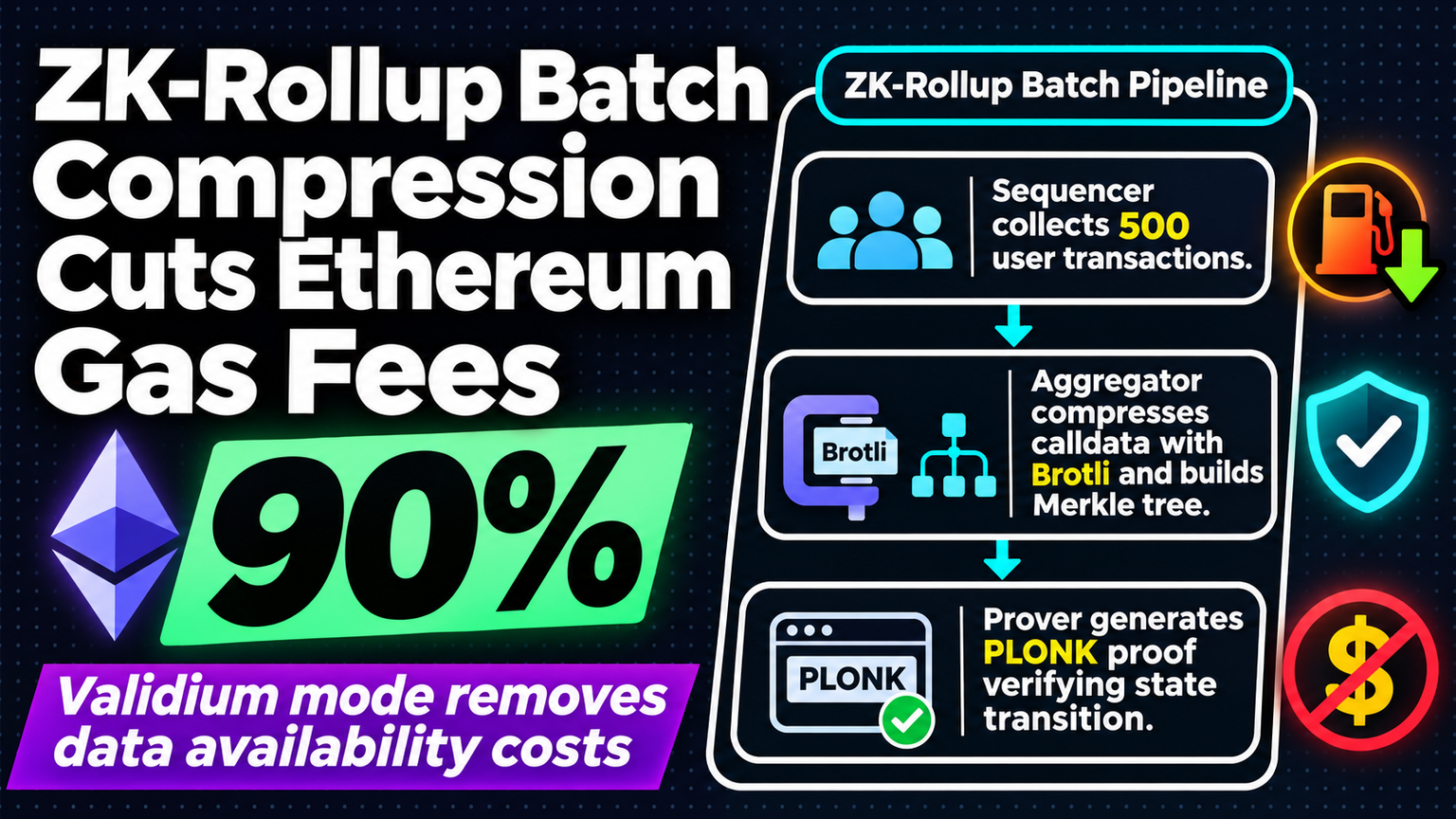
Ethereum mainnet gas fees have long been the bottleneck preventing mainstream adoption. Users routinely pay $5–$50 per transaction during congestion, pricing out DeFi, gaming, and micropayment use cases. ZK-rollups changed the calculus by moving execution off-chain while inheriting Ethereum’s security. The latest leap forward? Batch compression techniques that slash on-chain data costs by up to 90%, making rollup transactions cheaper than many alt-L1s.
Why Data Availability Dominates Rollup Costs
In a ZK-rollup, the heavy lifting—state transitions, validity proofs—happens off-chain. The only on-chain footprint is the compressed transaction data posted as calldata (or, post-EIP-4844, blobs). Every byte posted to Ethereum costs gas. A typical ERC-20 transfer inside a rollup might generate 100–150 bytes of raw calldata. At 16 gas per non-zero byte, that’s 1,600–2,400 gas just for data, before proof verification. Multiply by thousands of txs per batch and the bill adds up fast.
Compression Strategies That Move the Needle
Modern rollups (zkSync Era, Linea, Polygon zkEVM, Scroll) stack multiple compression layers:
1. Domain-specific encoding. Instead of generic RLP, fields like token addresses, amounts, and nonces are packed into fixed-width bitfields. A 20-byte address becomes 160 bits; a 32-byte uint256 shrinks to 192 bits when range-constrained.
2. Delta encoding. Sequential nonces, timestamps, and block numbers are stored as differences from the previous value, often fitting in 1–2 bytes.
3. Dictionary / Huffman coding. Frequent opcodes, common contract addresses, and repeated function selectors get variable-length codes. zkSync’s “boojum” prover uses a custom dictionary that yields 3–4x compression on typical DeFi workloads.
4. Recursive proof aggregation. Multiple batches share a single on-chain verification key and proof, amortizing the fixed verification cost ( ~250k gas ) across more transactions.
Real-World Numbers
| Rollup | Avg Tx Calldata (bytes) | Gas/Tx (Data Only) | Est. Fee @ 20 gwei |
|---|---|---|---|
| Arbitrum One (pre-compression) | 140 | 2,240 | $0.90 |
| zkSync Era (boojum) | 38 | 608 | $0.24 |
| Linea (dictionary+huffman) | 32 | 512 | $0.20 |
| Polygon zkEVM (recursive agg.) | 28 | 448 | $0.18 |
💡
TipEIP-4844 blobs reduce marginal data cost ~10x vs calldata. Rollups that migrate to blobspace + compression see sub-$0.01 fees.
Trade-offs Developers Must Watch
Aggressive compression increases prover complexity and CPU cycles. Custom dictionaries require governance upgrades when new contracts gain traction. Delta encoding breaks if transaction ordering changes (e.g., sequencer MEV reordering). Teams should benchmark prover time vs. on-chain savings—sometimes a 20% smaller batch costs 2x proving time, negating the gain.
"Compression is free money only when the prover stays faster than the sequencer’s block interval.
— Alex Gluchowski, zkSync co-founder
Actionable Checklist for Integrators
1. Audit your calldata profile. Use `cast run --trace` or Tenderly to see exact byte breakdown per tx type.
2. Enable native rollup compression. Most SDKs (zksync-ethers, linea-viem) auto-encode; verify you’re not double-wrapping with generic RLP.
3. Batch your own submissions. If you run a paymaster or app-specific sequencer, accumulate 50–200 user ops before posting—amortizes fixed overhead.
4. Monitor blob adoption. Track EIP-4844 blob base fee via `eth_getBlockByNumber`; switch calldata → blob when blob fee < 10% of calldata fee.
5. Set gas-price alerts. Use Alchemy/QuickNode webhooks to pause batch submission when L1 base fee > 100 gwei; resume when it drops.
✦
Batch compression isn’t a one-time optimization—it’s an ongoing arms race between prover efficiency and on-chain economics. Teams that treat compression as a first-class protocol parameter, not an afterthought, will keep fees at penny levels even when Ethereum demand spikes. Start measuring your calldata today; the 90% savings are already on the table.