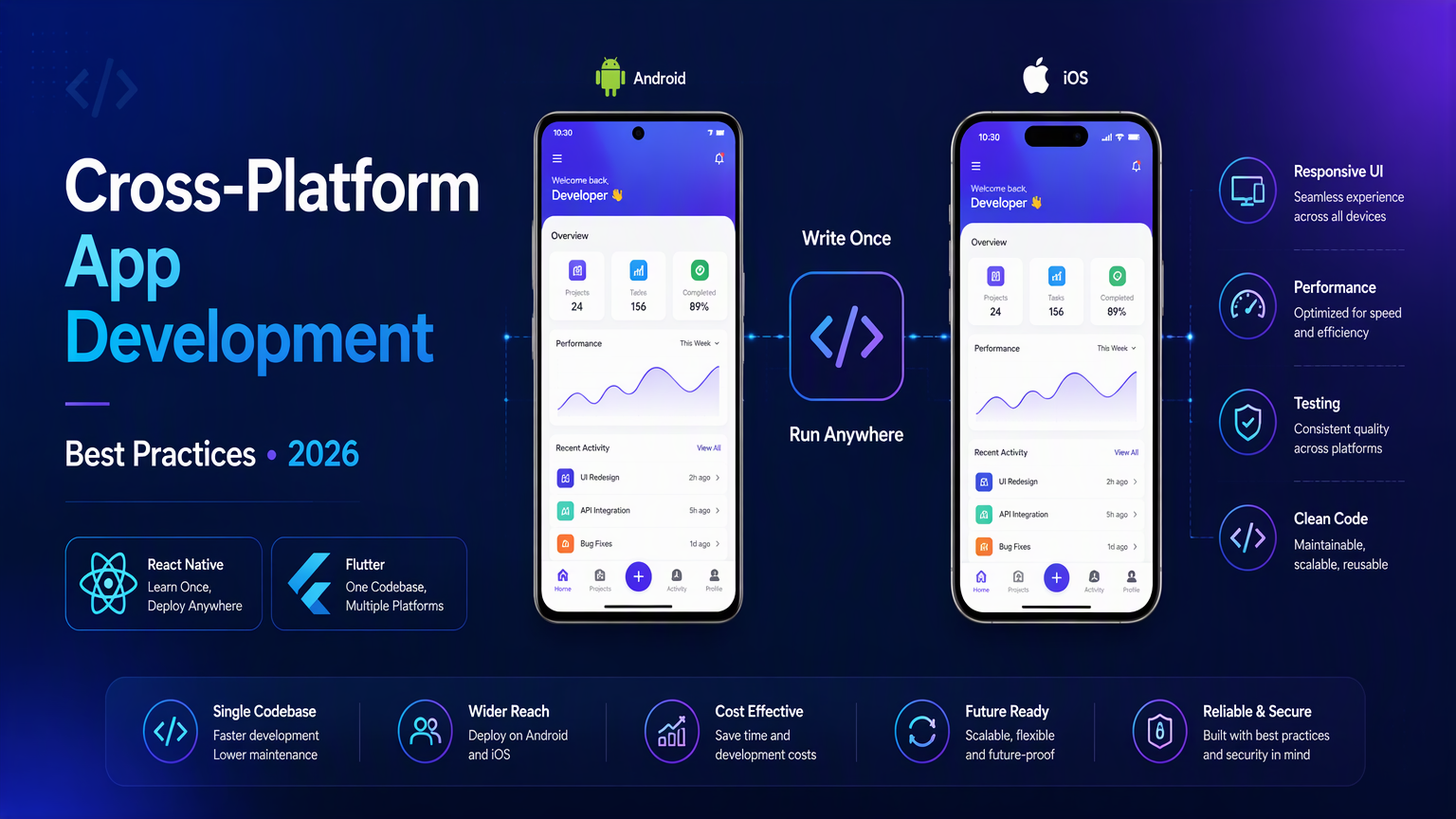
Cross-platform development isn't about compromise anymore. It's about choosing the right trade-offs for your specific constraints. In 2024, the gap between native and cross-platform performance has narrowed to milliseconds, but the architectural decisions you make today will determine whether you ship in six weeks or six months.
Pick Your Runtime, Not Just Your Framework
Flutter compiles to ARM machine code via Dart's AOT compiler. React Native bridges JavaScript to native modules through JSI. Kotlin Multiplatform shares business logic while keeping UI native. These aren't interchangeable choices—they're fundamentally different runtime architectures.
💡
TipMatch the runtime to your team's strongest language. Forcing Kotlin devs into Dart or React devs into Kotlin adds 30-50% ramp time.
UI Strategy: Unified vs. Platform-Specific
Flutter's widget tree gives you pixel-perfect consistency across iOS and Android. That's a feature for brand-heavy apps, a liability for apps that need to feel native. React Native and KMP let you drop into SwiftUI or Jetpack Compose when platform conventions matter.
State Management: Keep It Boring
Every framework has five state solutions. Pick the one with the best debugging tools and community answers on Stack Overflow. For Flutter, that's Riverpod or Bloc. For React Native, it's Zustand or Redux Toolkit. For KMP, it's Kotlin Flow with Compose. Novelty in state management is technical debt.
"The best state management library is the one your junior dev can debug at 2 AM without reading docs.
— Senior Mobile Lead, Fintech Unicorn
Performance Budgets That Actually Ship
Set hard limits before you write code. Target 16ms frame budget (60fps), <100ms cold start, <50MB memory baseline. Profile on low-end devices—a 2019 Moto G Power, not your iPhone 15 Pro. CI pipelines should fail builds that regress these metrics.
| Metric | Good | Warning | Fail |
|---|---|---|---|
| TTI (Time to Interactive) | <2.5s | 2.5-4s | >4s |
| Frame Drops (95th %ile) | 0 | 1-3 | >3 |
| Bundle Size (gzipped) | <50MB | 50-100MB | >100MB |
| Crash-Free Sessions | 99.9% | 99.5-99.9% | <99.5% |
Native Bridges: The Hidden Cost Center
Every platform channel call in Flutter, every native module in React Native, every expect/actual in KMP adds serialization overhead and failure surface. Audit your native dependencies monthly. Replace three analytics SDKs with one. Write the custom native module once instead of wrapping five CocoaPods.
⚠️
WarningUnmaintained native bridges are the #1 cause of App Store rejection and Play Store removal in cross-platform apps.
Testing Pyramid for Dual Platforms
Unit test shared logic (70%). Integration test critical user flows on both platforms (20%). E2E test happy paths only (10%). Skip snapshot testing—it catches layout shifts, not bugs. Run device farms in parallel: Firebase Test Lab for Android, Xcode Cloud for iOS.
Shipping Checklist for Friday Deploys
Automate everything that can be automated. CodePush for React Native hotfixes. Shorebird for Flutter patches. Play Console and App Store Connect APIs for staged rollouts. Feature flags for every new screen. If you can't roll back in 5 minutes, you're not ready to ship.
✦
Next step: Pick one framework. Build the same three-screen app (list, detail, settings) in Flutter, React Native, and KMP. Measure cold start, bundle size, and developer hours. Let data, not Twitter threads, drive your 2024 stack decision.