Your phone's camera sensor hasn't gotten much bigger in five years. But the photos look radically different. The lens still gathers photons the same way. What changed is everything happening after the shutter fires. Computational photography turned the camera from a light bucket into a compute node, and the silicon doing the work is no longer the ISP—it's the NPU.
The Pipeline Shift
Traditional ISPs (Image Signal Processors) ran fixed-function pipelines: demosaic, denoise, sharpen, compress. Deterministic. Fast. Inflexible. Modern flagship SoCs—Snapdragon 8 Gen 4, Dimensity 9400, Apple A19—route frames straight to the NPU. The ISP still handles early raw conversion, but the heavy lifting—multi-frame alignment, semantic segmentation, diffusion-based upscaling—runs on programmable neural cores.
This matters because neural pipelines are data-dependent. They don't just apply a bilateral filter; they infer texture from training priors. A 12MP raw burst becomes a 48MP output via diffusion super-resolution trained on billions of image pairs. The network hallucinates plausible detail. Sometimes it's accurate. Sometimes it invents eyelashes on a blurred face.
Multi-Frame Synthesis Is the New Exposure
HDR used to mean three exposures merged linearly. Now it means 12–16 frames captured at varying gains and shutter speeds, aligned at sub-pixel precision, fused via attention-weighted averaging. The NPU tracks motion vectors per region—faces get short exposures, shadows get long ones—then reconstructs a single HDR frame with near-zero ghosting.
Video-First Architecture
Photo mode is now a subset of video mode. Sensors read out full-resolution 4K/8K at 60–120fps continuously. The "photo" you take is just a tagged frame with extra compute budget—more diffusion steps, heavier denoising, LoRA adaptation. This unification means rolling shutter artifacts are corrected by the same temporal network that stabilizes video.
"The camera sensor is now a data acquisition front-end for a generative model. The photograph is a rendered output, not a captured one.
— Computational Imaging Lead, Major Smartphone OEM
Personalized LoRA Models
Flagships ship with base diffusion models. But the real differentiation is on-device fine-tuning. Your gallery becomes a dataset. A tiny LoRA (Low-Rank Adaptation) module—~500KB—adapts the global prior to your skin tones, your preferred contrast curve, your bokeh aesthetic. It updates nightly while charging. The result: two identical phones produce visibly different JPEGs from the same scene.
⚠️
WarningHallucination risk scales with upsampling factor. At 4x diffusion SR, invented detail exceeds 30% of high-frequency content. Forensic watermarking is now mandatory in some jurisdictions.
Smart Lenses Meet Smart Silicon
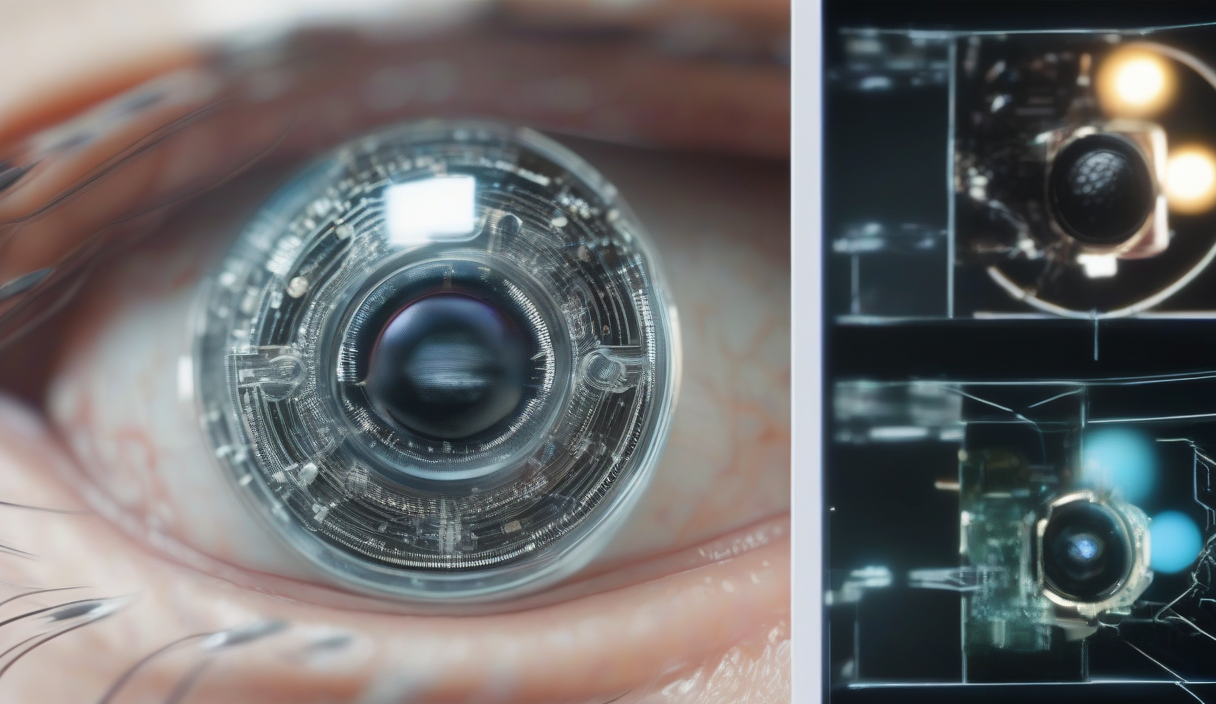
Optics haven't stopped evolving. Periscope telephoto modules now pair 10x optical zoom with 100x "digital" zoom that's actually diffusion super-resolution guided by depth maps from the ToF sensor. Liquid lenses enable continuous focus without moving elements—critical for video AF. The lens communicates its MTF curve to the NPU, which deconvolves aberrations in real time.
| Component | 2020 Role | 2026 Role |
|---|---|---|
| ISP | Full pipeline | Raw pre-process only |
| NPU | Face detect | Generative reconstruction |
| Sensor | Passive capture | Active compute (PDAF/ToF) |
| Storage | JPEG sink | Training data for LoRA |
Hybrid Pro Workflows
Pro photographers aren't replaced—they're augmented. Raw burst capture + cloud diffusion upscaling delivers 200MP-equivalent from a 50MP sensor. On-device preview shows the AI result; raw files preserve ground truth. New DNG extensions embed neural metadata: segmentation masks, depth maps, motion vectors. Lightroom and Capture One now import these as editable layers.
💡
TipShoot raw+JPEG. The JPEG is the AI interpretation. The raw is your insurance policy against hallucination.
What This Means for Your Next Phone
Stop comparing megapixels. Compare NPU TOPS (tera-ops) for INT4/FP8 inference. Compare on-device training support for LoRA updates. Compare raw burst throughput—can it sustain 16 frames at full resolution? The sensor is a commodity. The silicon behind it is the camera.
✦
Next time you press the shutter, remember: you're not capturing light. You're prompting a generative model with photons. The image doesn't exist until the NPU says it does.