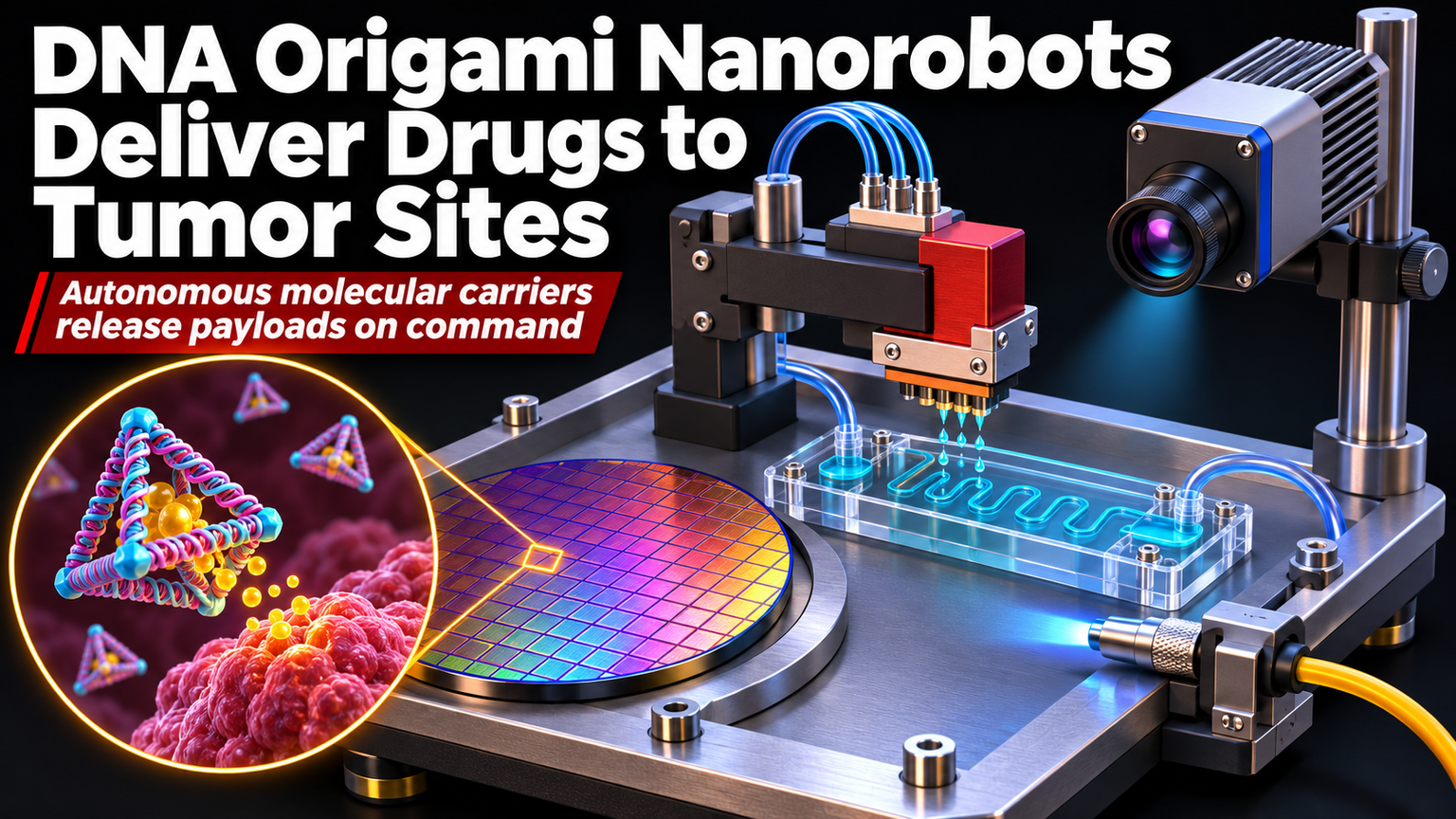
Imagine a fleet of microscopic robots, each smaller than a virus, navigating your bloodstream with a singular mission: seek out cancer cells and unload a lethal payload while leaving healthy tissue untouched. This isn't science fiction. It's DNA origami, and it's rapidly moving from the lab bench to the clinic.
Folding Code into Structure
DNA origami exploits the predictable base-pairing rules of DNA (A-T, C-G) to fold a long 'scaffold' strand into precise 2D and 3D shapes using hundreds of short 'staple' strands. Since Paul Rothemund's 2006 breakthrough, the technique has evolved from static art — smiley faces, maps of the Americas — into dynamic, programmable nanodevices. These structures aren't just containers; they are machines capable of logic gating, mechanical actuation, and molecular sensing.
Loading the Cargo
The therapeutic versatility is staggering. Researchers load these scaffolds using three primary strategies:
| Method | Mechanism | Payload Examples |
|---|---|---|
| Intercalation | Molecules slide between base pairs | Doxorubicin, daunorubicin |
| Covalent conjugation | Chemical linkers attach to modified staples | siRNA, antibodies, peptides |
| Encapsulation | Hollow structures trap cargo inside | Enzymes, CRISPR complexes, nanoparticles |
This multimodal capacity means a single nanorobot can carry chemotherapy, gene-silencing RNA, and an imaging agent simultaneously — a combination therapy in one programmable package.
Finding the Target
Passive accumulation via the Enhanced Permeability and Retention (EPR) effect gets nanorobots into tumor neighborhoods. But active targeting — aptamers that bind cancer-specific surface proteins, folate receptors overexpressed on many carcinomas, or pH-sensitive ligands — turns neighborhood-level delivery into doorstep precision. Recent work demonstrates dual-targeting logic: the nanorobot only opens when both target markers are present, dramatically reducing off-target effects.
"We're not just delivering drugs anymore. We're programming the conditions of release. That's the difference between a package and a robot.
— Dr. Shawn Douglas, UCSF
Smart Release: Stimuli-Responsive Triggers
The real engineering elegance lies in the trigger mechanisms. DNA origami nanorobots stay locked during circulation but spring open in the tumor microenvironment:
| Trigger | Mechanism | Advantage |
|---|---|---|
| Low pH (6.5–6.8) | Acid-labile linkers or i-motif structures unfold | Exploits tumor acidosis |
| Enzymes (MMPs, nucleases) | Peptide/DNA linkers cleaved by overexpressed proteases | High specificity to invasive fronts |
| Redox (high GSH) | Disulfide bonds break in reducing cytoplasm | Intracellular release after uptake |
| Light/heat | Photothermal or plasmonic heating melts staples | External spatiotemporal control |
💡
TipDesign tip: Combine two triggers (e.g., pH + enzyme) for AND-gate logic. This prevents premature release in acidic but non-cancerous tissues like the stomach or inflammatory sites.
Overcoming Biological Barriers
Size, shape, and surface chemistry dictate fate in vivo. Rods and tubes (50–100 nm long) evade renal clearance better than spheres and show enhanced tumor penetration. PEGylation and CD47 'don't eat me' peptides extend circulation half-life from minutes to hours. Mechanical stiffness matters too: softer origami deforms to squeeze through dense tumor stroma; rigid structures resist lysosomal degradation. Tuning these parameters is now a design variable, not a constraint.
From Mice to Medicine
In vivo results are compelling. A 2025 study showed DNA origami nanorobots carrying doxorubicin achieved 87% tumor growth inhibition in xenograft models with zero cardiotoxicity — the dose-limiting side effect of free doxorubicin. Another trial demonstrated CRISPR-Cas9 delivery for PD-1 knockout in T cells in situ, turning the tumor microenvironment into a CAR-T factory. Clinical translation faces three hurdles: scalable GMP manufacturing, immunogenicity of bacterial scaffold DNA, and regulatory pathways for 'active' nanomachines. But the FDA's 2024 guidance on nucleic acid nanodevices signals a clear path forward.
ℹ️
NoteKey metric: Current yield for clinical-grade origami exceeds 90% via automated liquid-handling pipelines. Cost per dose projected under $500 at scale.
Your Next Steps
If you're in drug development, start prototyping your payload in origami now. Open-source tools like cadnano, vHelix, and DAEDALUS let you design structures in hours. Partner with a DNA synthesis foundry (Twist, IDT, or academic core facilities) for staple pools. Validate folding with gel electrophoresis and AFM, then test loading efficiency via fluorescence quenching assays. The barrier to entry is lower than ever — and the therapeutic ceiling is virtually unlimited.
✦
DNA origami nanorobots represent the convergence of molecular biology, computer science, and mechanical engineering. They don't just carry drugs — they execute algorithms inside living systems. The era of programmable medicine has arrived. Build something.