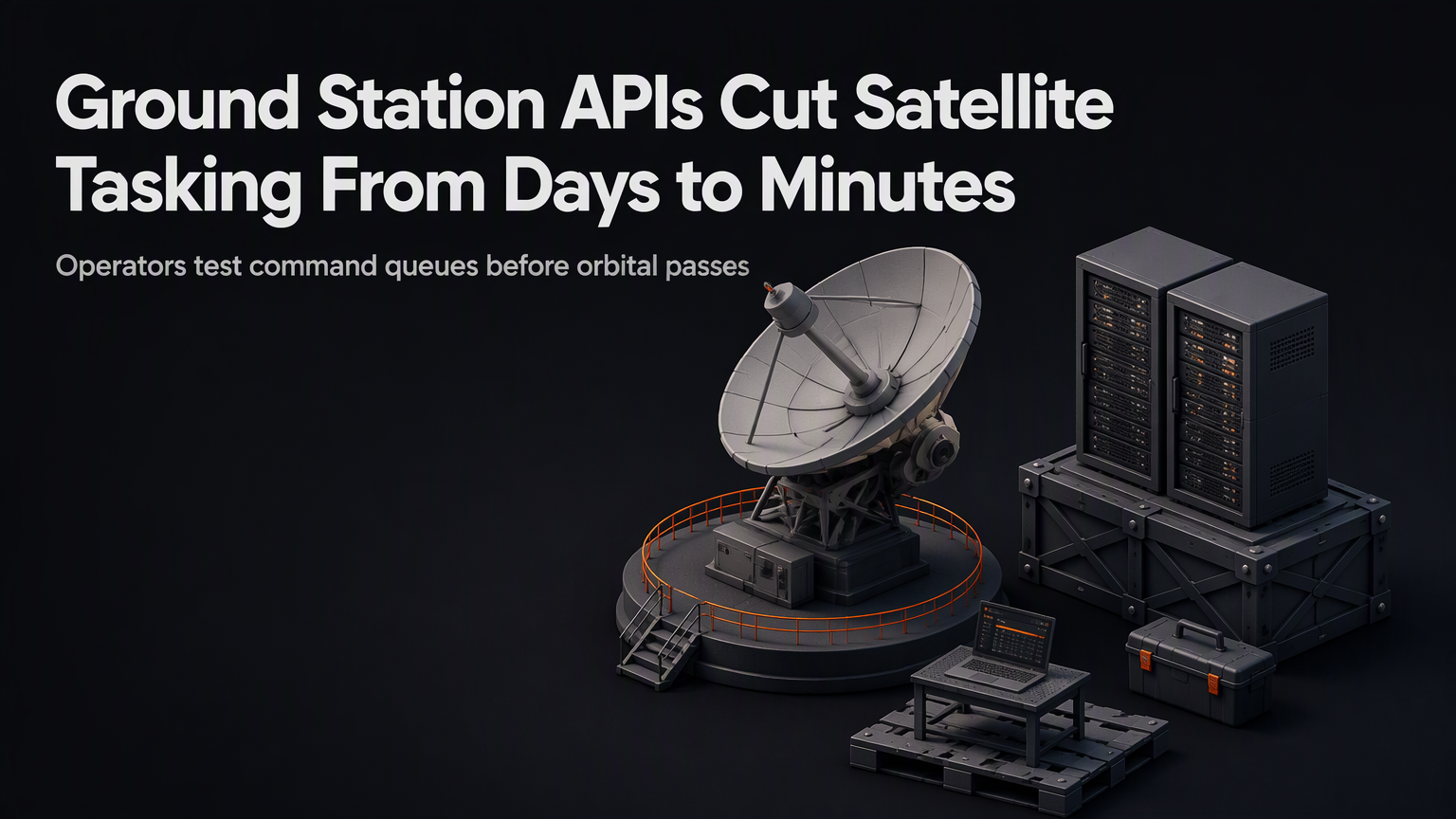
You've launched the satellite. The bus is healthy. The payload checks out. Now you need to talk to it. Three years ago, that meant emailing a ground station operator, negotiating a contract, waiting for a schedule slot, and praying the weather held. Today, you hit an API endpoint and get a pass in minutes.
The Ground Segment Bottleneck
Space is easy now. Launch costs have plummeted. Satellite buses are commoditized. Constellations like Starlink prove you can operate thousands of nodes in LEO with laser interlinks pushing 100+ Gbps. But every bit of data eventually has to touch dirt. The ground segment—antennas, modems, fiber backhaul, scheduling logic—has not kept pace.
Legacy ground networks run on spreadsheets, phone calls, and static IFIC filings. A typical tasking cycle: submit a request 72 hours ahead, wait for confirmation, receive a static TLE-based schedule, hope the satellite doesn't maneuver. If weather hits a site, you lose the pass. No failover. No real-time rebooking.
"The bottleneck isn't the bird. It's the dish. And the software that drives it.
— AWS Ground Station Team
API-First Ground Stations
Services like AWS Ground Station, Azure Orbital, and KSAT Lite expose the entire contact lifecycle as REST and GraphQL APIs. You don't book a dish; you request a contact window. The backend handles site selection, frequency licensing, modem configuration, and data delivery to your S3 bucket or Kafka topic.
This code replaces a 3-day procurement cycle. The API returns real-time availability across a global network, factors in weather forecasts, and provisions the modem config (DVB-S2X, custom waveforms) automatically. You get a contact ID. The antenna tracks. Data flows.
Orbit Scheduling as Code
The real power emerges when you treat scheduling as a continuous optimization problem. Instead of static passes, you feed TLEs, payload priorities, and downlink budgets into a solver that re-optimizes every 15 minutes.
| Metric | Legacy Process | API-Driven |
|---|---|---|
| Lead Time | 72+ hours | < 5 minutes |
| Weather Failover | Manual rebook | Automatic re-route |
| Modem Config | Manual per pass | Software-defined |
| Data Delivery | Ship disks / SFTP | Stream to cloud storage |
| Cost Model | Per-pass contract | Per-second usage |
💡
TipTag your contacts with metadata (orbit_id, payload_mode, priority). The scheduler uses these weights to preempt low-priority passes when a high-value target appears.
Telemetry Pipelines, Not File Transfers
Modern ground station APIs don't just hand you a .bin file. They stream demodulated frames directly into your processing pipeline. AWS delivers VITA-49 packets to Kinesis Data Streams. Azure pushes to Event Hubs. You decode, decrypt, and route in real time—no staging server required.
This shifts the architecture from batch to stream. Anomaly detection runs on the first frame, not the next morning's downlink report. You can command the payload mid-pass based on live telemetry. Close the loop in seconds.
Segment Automation in Practice
Planet runs 200+ Dove satellites. They use ground station APIs to schedule 1,000+ contacts daily across 15+ sites. Their automation layer ingests weather APIs, satellite health telemetry, and customer tasking requests. A Kubernetes operator reconciles desired contacts vs. actual reservations, auto-scaling ground capacity like cloud compute.
What's Next
Optical ground stations (OGS) are entering beta. They offer 10-100x RF throughput but demand sub-arcsecond pointing and clear skies. APIs will abstract the complexity: you request bandwidth, the system picks RF or optical based on cloud cover forecasts. Multi-tenant antennas will timeslice a single dish across 50+ satellites using phased array feeds. The ground segment finally becomes elastic infrastructure.
ℹ️
NoteStart now: provision a dev sandbox with AWS Ground Station or Azure Orbital. Schedule a test pass against a public satellite (NOAA, ISS). Build your telemetry ingest pipeline. The API is free; you pay only for antenna minutes used.
✦
Stop negotiating passes. Start coding them. The ground segment is now programmable infrastructure. Treat it like EC2, not a telco contract.