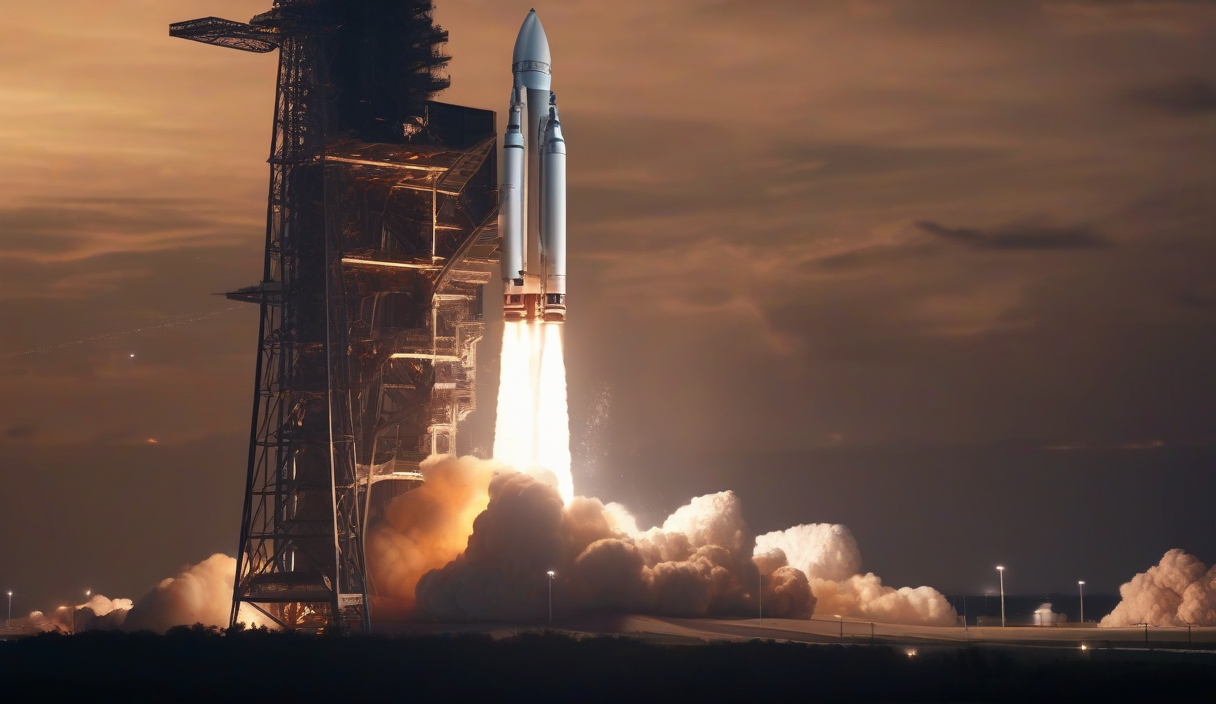
The space industry isn't just accelerating—it's fundamentally changing how we move through the void. In 2026, the propulsion conversation shifts from incremental ISP gains to architecture-defining breakthroughs. Nuclear thermal rockets, megawatt-class ion drives, and operational solar sails are leaving the lab for the launch pad. Here's what matters for the next decade of deep space operations.
Nuclear Thermal Propulsion: From Paper to Hardware
NASA and DARPA's DRACO program targets a 2027 flight demo, but 2026 is the critical integration year. The reactor uses high-assay low-enriched uranium (HALEU) fuel to heat hydrogen to 2,500K, delivering 900+ seconds ISP—double chemical rockets. This cuts Mars transit to 3-4 months, slashing crew radiation exposure and consumables mass. BWXT and Lockheed Martin are welding flight hardware now; the first critical design review cleared in late 2025.
ℹ️
NoteNTP enables abort-to-Earth trajectories impossible with chemical propulsion—a safety architecture shift for crewed deep space.
Megawatt-Class Electric Propulsion
Hall thrusters are scaling past 100kW. NASA's AEPS (Advanced Electric Propulsion System) hits 12kW per string; cluster four and you're at 50kW. But 2026 brings the first ground tests of 250kW+ nested-channel Hall thrusters and magnetically shielded designs that solve erosion life limits. Pair with Kilopower fission or roll-out solar arrays (ROSA) and you get cargo tugs that haul 20t to lunar orbit or push science payloads to the ice giants without gravity assists.
| Technology | ISP (s) | Thrust | Status 2026 |
|---|---|---|---|
| NTP (DRACO) | 900+ | 25,000 lbf | Flight hardware integration |
| AEPS Hall | 2,800 | 0.6 N/string | Qualification testing |
| Nested Hall (250kW) | 3,000+ | 12+ N | Ground demo |
| Solar Sail (ACS3) | Infinite | 0.001 N | Operational demo |
Solar Sails Go Operational
NASA's ACS3 (Advanced Composite Solar Sail System) launches 2025; 2026 proves the deployment mechanics and attitude control in orbit. The composite booms are 75% lighter than metallic predecessors. No propellant means unlimited delta-v for station-keeping at Sun-Earth L1/L2, polar solar observation, or slow-spiral asteroid rendezvous. The breakthrough isn't the sail—it's the boom packaging and autonomous shape control that finally makes large sails reliable.
"Propulsion is no longer the bottleneck. Power generation and thermal rejection are.
— Dr. Robert Braun, former NASA Chief Technologist
Plasma Engines: VASIMR and Applied Field Magneto-Plasma
Ad Astra's VASIMR VX-200SS hits steady-state 200kW tests in 2026, validating the RF coupling and magnetic nozzle efficiency at flight-relevant power. Meanwhile, Princeton's Applied Field Magnetoplasmadynamic (AF-MPD) thruster demonstrates lithium-fed operation at 500kW with 50% anode efficiency. These aren't ready for crewed Mars—yet—but they define the 1-2MW electric tug architecture for 2030s outer planet missions.
💡
TipWatch the power processing unit (PPU) mass fraction. At 250kW+, PPU and thermal management dominate dry mass—not the thruster.
What This Means for Mission Design
Propulsion breakthroughs rewrite trade trees. NTP enables fast crew transits; megawatt electric hauls infrastructure; sails provide free station-keeping. The 2026 milestone isn't any single engine—it's the convergence of multiple mature options. Mission architects can now match propulsion to mission phase: chemical for launch, NTP for crew sprint, electric for cargo spiral, sail for long-term loiter.
✦
Track the DRACO flight review, AEPS life test completion, and ACS3 on-orbit deployment telemetry. Those three data streams define the 2030 deep space logistics map. If you're designing missions, start baselining mixed-propulsion architectures now—the hardware is real.