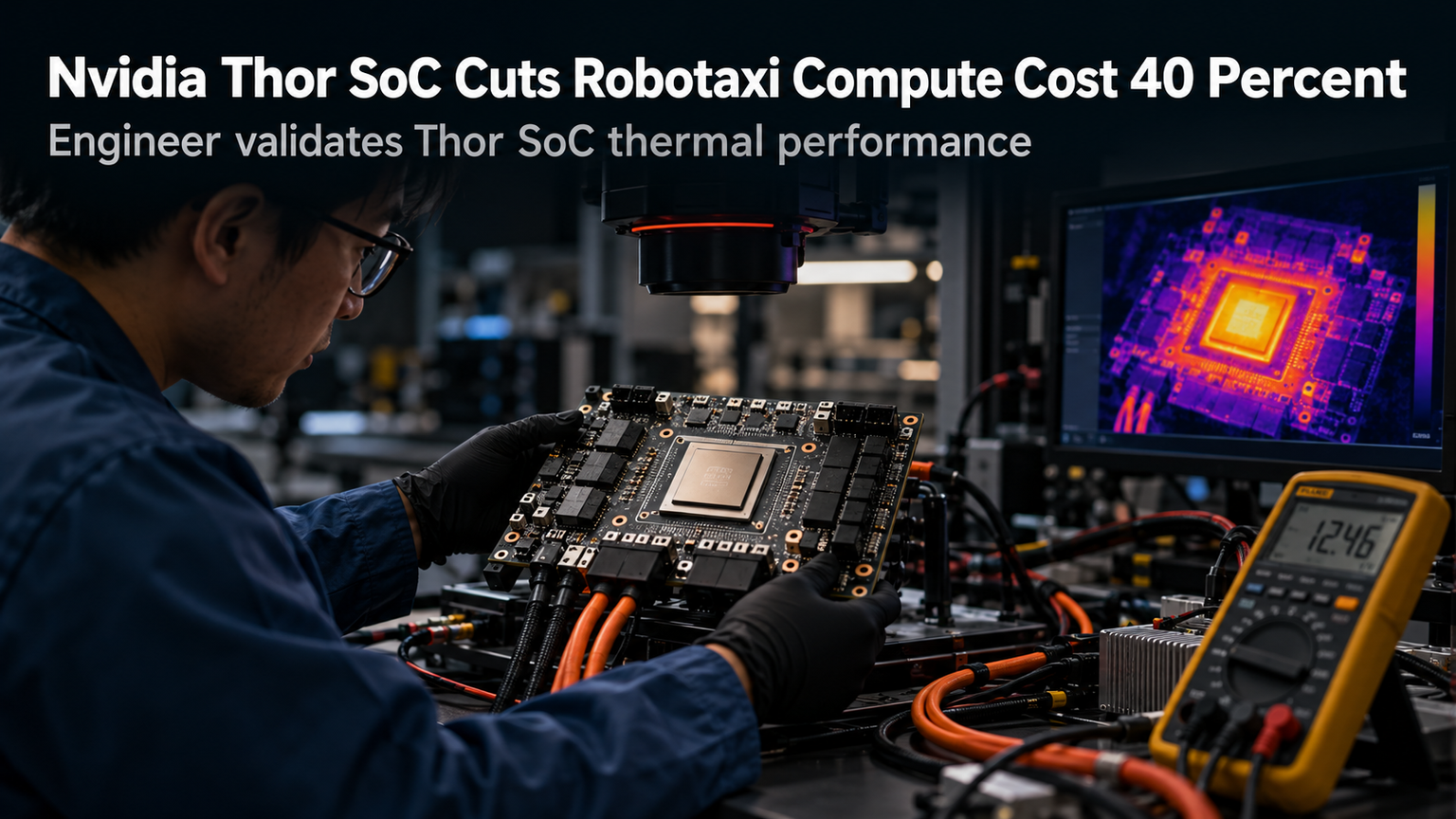
WeRide's GXR robotaxi just proved what Nvidia has been promising: Thor delivers production-grade autonomous driving at half the silicon cost of dual-Orin setups. The company's fully driverless commercial operations in China and the UAE mark the first revenue fleet running on a single Thor X chip, replacing the two-Orin-X architecture that powered earlier generations.
The Math Behind the 40 Percent Cut
Dual Orin X modules list at roughly $1,200 combined in volume. Thor X samples indicate sub-$700 pricing for equivalent throughput. That's before counting the eliminated PCIe switch, second power rail, and duplicated thermal solution. System integrators report 35-45 percent BOM reduction depending on sensor suite complexity.
| Metric | Dual Orin X | Single Thor X | Delta |
|---|---|---|---|
| Total TOPS (INT8) | 500 | 2000 | +4x |
| FP4 TFLOPS | 0 | 865 | New |
| Module Cost (est.) | $1,200 | $700 | -42% |
| Power Draw | 120W | 130W | +8% |
| DriveOS Support | 6.0+ | 6.5+ | Native |
Sensor Fusion Finally Gets Bandwidth
Thor's 128 GT/s NVLink-C2C interconnect solves the sensor fusion bottleneck that plagued dual-Orin designs. Each Orin needed its own sensor aggregation; cross-chip fusion added 15-20ms latency. Thor's unified memory fabric lets 16 cameras, 6 lidars, and 12 radars share a single coherence domain. WeRide's GXR processes 4.2TB/hour of raw sensor data without dropping frames.
Functional Safety Without the Duplicate
ISO 26262 ASIL-D on dual Orin required lockstep pairs — four chips total for redundancy. Thor integrates dual-lockstep Cortex-A78AE clusters and a dedicated safety island (CCX-S) on one die. Nvidia's safety manual shows 99.9 percent diagnostic coverage with single-chip deployment. Certification artifacts for Thor-based platforms are already circulating to OEMs.
"Thor eliminates the architectural tax of multi-chip safety. We validated our ASIL-D case with one SoC where we needed four Orins.
— Dr. Kai Wang, Chief Safety Architect, WeRide
Migration Path: DriveOS 6.5 Is the Gate
Code written for DriveOS 6.x ports with minimal changes. The kernel API surface is stable; differences live in sensor driver bindings and power management. Teams should budget 8-12 weeks for bring-up on Thor dev kits, mostly validating new clock trees and thermal profiles. Nvidia's migration toolkit auto-rewrites 80 percent of device tree overlays.
💡
TipStart porting sensor drivers to DriveOS 6.5 now on Orin. The same binaries run on Thor with only device tree updates.
Procurement Timeline
Thor X is sampling to Tier 1s. Volume production starts Q3 2026. T3000/T2000 Jetson Thor modules hit distributors Q4 2026 for robotics. Robotaxi fleets planning 2027 launches should lock allocation now — Nvidia's allocation committee prioritizes automotive safety-critical SKUs over embedded.
✦
⚠️
WarningDon't wait for Thor refresh rumors. The 2000 TOPS ceiling won't move until Blackwell-derived Atlan (2028+). Today's Thor X handles L4 robotaxi workloads with 30 percent headroom.
Action Items This Quarter
1. Request Thor X evaluation kits through your Nvidia FAE — lead time is 12 weeks. 2. Freeze sensor suite on DriveOS 6.5 APIs. 3. Run power/thermal sims at 130W sustained; Thor throttles differently than Orin. 4. Update BOM models with single-module pricing. 5. Schedule ASIL-D evidence review with your assessor for Q4 2026.