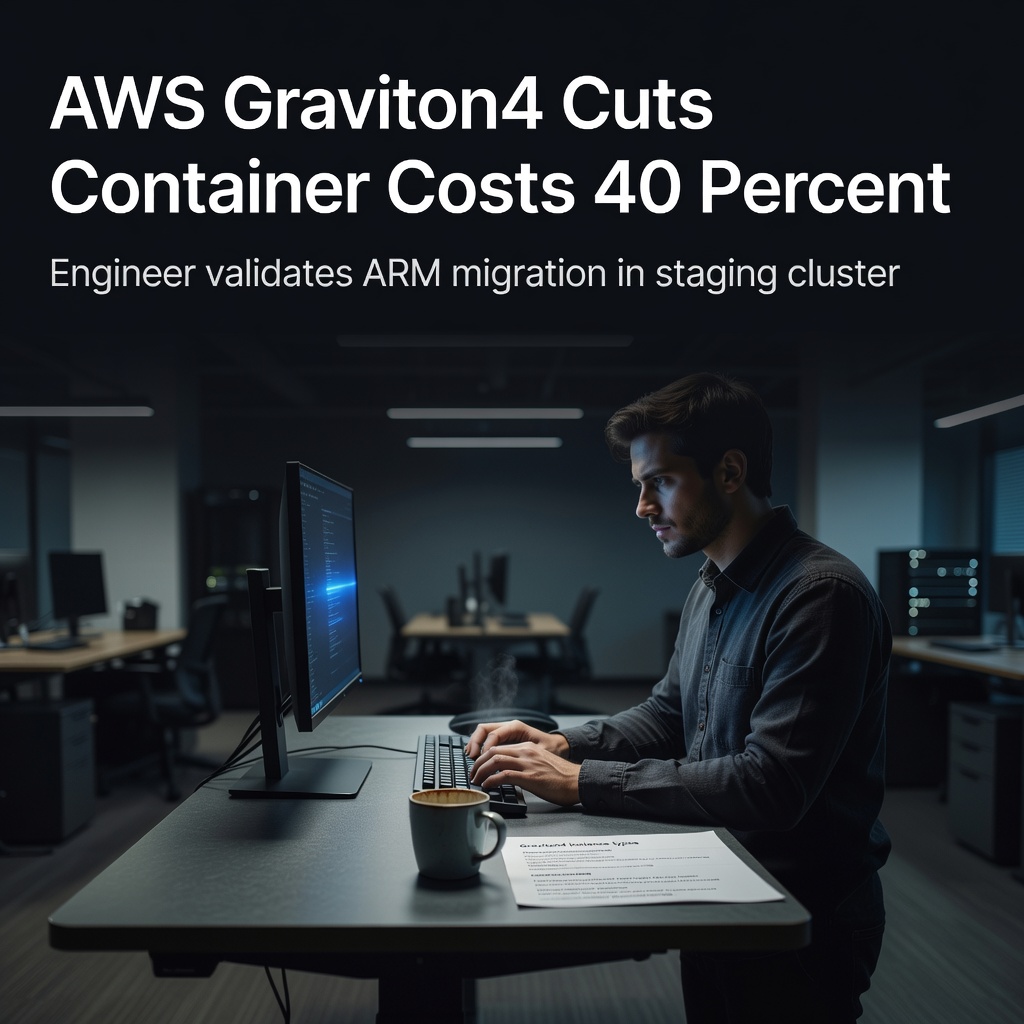
AWS Graviton4 just proved ARM can outrun x86 in production Kubernetes. SquareOps migrated 50-plus EKS clusters and measured 20 to 40 percent compute savings without rewriting a single line of application code. The Neoverse V2 cores deliver 30 percent more raw compute than Graviton3, and the price-performance gap has widened enough that most container workloads now run cheaper on ARM.
Why Graviton4 Changes the Math
Previous Graviton generations required careful workload selection. Graviton4 removes that friction. The Neoverse V2 architecture brings higher clock speeds, larger caches, and improved memory bandwidth. For typical cloud-native stacks — Node.js APIs, Java Spring Boot services, Go microservices — the instruction-per-cycle gains translate directly to lower instance counts.
"We stopped asking 'does this run on ARM?' and started asking 'why is this still on x86?'
— SquareOps Platform Lead
Real Numbers from 50+ Clusters
| Workload Type | Instance Before | Instance After | Compute Savings |
|---|---|---|---|
| Node.js API | c6i.xlarge | c7g.xlarge | 38% |
| Java Spring Boot | c6i.2xlarge | c7g.2xlarge | 32% |
| Go Microservice | c6i.large | c7g.large | 41% |
| Python Data Pipeline | c6i.4xlarge | c7g.4xlarge | 28% |
These figures reflect on-demand pricing. Layer in Compute Savings Plans and Karpenter-driven right-sizing, and the blended savings push past 40 percent. Karpenter matters because it provisions Graviton nodes only when pods actually need them, eliminating the over-provisioning that eats ARM savings on static clusters.
💡
TipEnable Karpenter with nodePool labels for architecture: arm64. Set spot consolidation to aggressive. Watch the node count drop.
Migration Checklist
Most teams overestimate the effort. The actual blockers are usually external, not code:
Hidden Gotchas
Java applications need JVM tuning. Default ergonomics assume x86 core counts. Set -XX:ActiveProcessorCount to match the vCPU limit, not the host. Node.js benefits from --max-old-space-size adjustments when moving to smaller Graviton instances. Go binaries compile natively — just rebuild with GOARCH=arm64.
⚠️
WarningWatch for x86-only kernel modules. eBPF tools, some security agents, and legacy kernel drivers may lack arm64 builds. Vendor support has improved dramatically in 2026, but verify before cutover.
FinOps Integration
Tag every Graviton node with architecture:arm64 and processor:graviton4. Feed these tags into your cost allocation reports. The FinOps team can then show line-item savings per service, per environment, per team. That visibility turns a one-time migration into a recurring budget win.
✦
Start This Week
Pick your lowest-risk stateless service. Build the arm64 image. Deploy to a Karpenter-managed Graviton4 node pool in staging. Measure latency, error rate, and cost per million requests. If the numbers hold — and they will — schedule the rest of the fleet. The 40 percent floor is real. The ceiling depends on how fast you move.