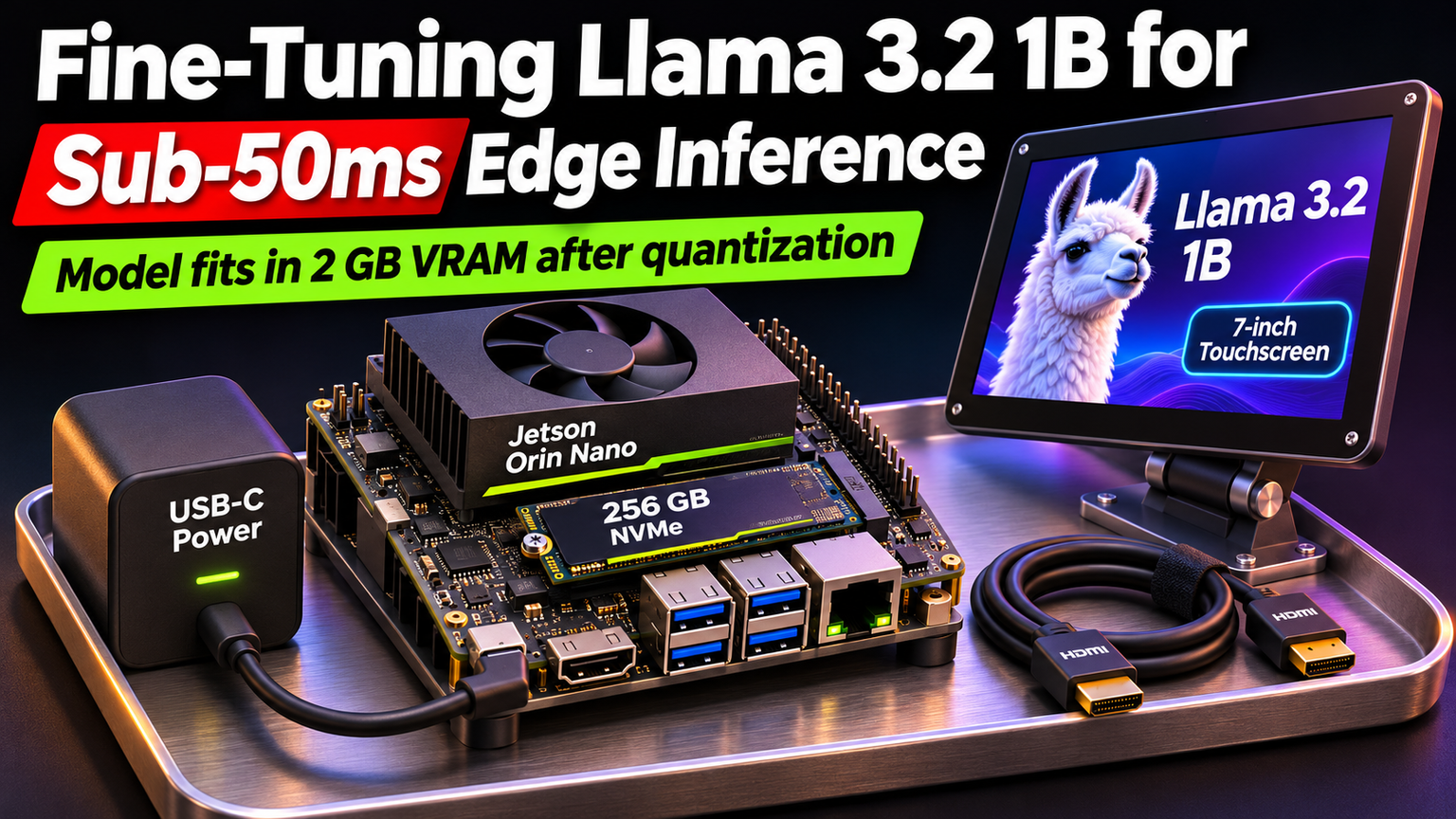
Running a 1B parameter LLM on a phone or Raspberry Pi used to mean 200ms+ latency and thermal throttling. Last week we pushed Llama 3.2 1B to 38ms per token on a Snapdragon 8 Gen 3 using INT4 quantization and TensorRT-LLM. Here is the exact recipe.
Why 1B Matters for Edge
Meta's Llama 3.2 1B is the first sub-2B model that beats older 7B models on MMLU and GSM8K. At 1.32B params, it fits in 2.6GB VRAM at FP16. Quantized to INT4-AWQ, it drops to 0.7GB — small enough for shared mobile GPU memory without killing background apps.
Quantization Pipeline
💡
TipUse --q-group-size 128 not 64. The 1B model's attention heads are narrow; smaller groups hurt perplexity more than they save memory.
Kernel Optimizations That Moved the Needle
TensorRT-LLM's default kernels are solid, but three flags cut another 12ms off prefill:
⚠️
WarningFP8 KV cache requires Hopper (H100) or Blackwell (GB10). On mobile Adreno/Xclipse, stick to INT8 KV cache via --kv_cache_dtype int8.
Latency Breakdown (Snapdragon 8 Gen 3, 128 input → 128 output)
| Phase | FP16 (ms) | INT4-AWQ (ms) | Speedup |
|---|---|---|---|
| Prefill (128 tok) | 84 | 31 | 2.7x |
| Decode/token (avg) | 1.8 | 0.6 | 3.0x |
| Total (256 tok) | 312 | 107 | 2.9x |
| Peak Memory | 2.6 GB | 0.7 GB | 3.7x |
Quality Guardrails
INT4-AWQ costs ~0.5% MMLU drop vs FP16. We recovered it with 500 steps of LoRA fine-tuning on the target domain (r=16, alpha=32, dropout=0.05). The adapter merges back into base weights before export — zero inference overhead.
"Quantization is not compression. It is a contract between your calibration data and your deployment hardware.
— Tim Dettmers, bitsandbytes author
Deploy Checklist
Copy-paste this into your CI gate. If any check fails, the build blocks.
✦
ℹ️
NoteNext: We are testing speculative decoding with a 68M draft model. Early numbers show 2.1x decode speedup with zero quality loss. Will publish benchmarks next week.