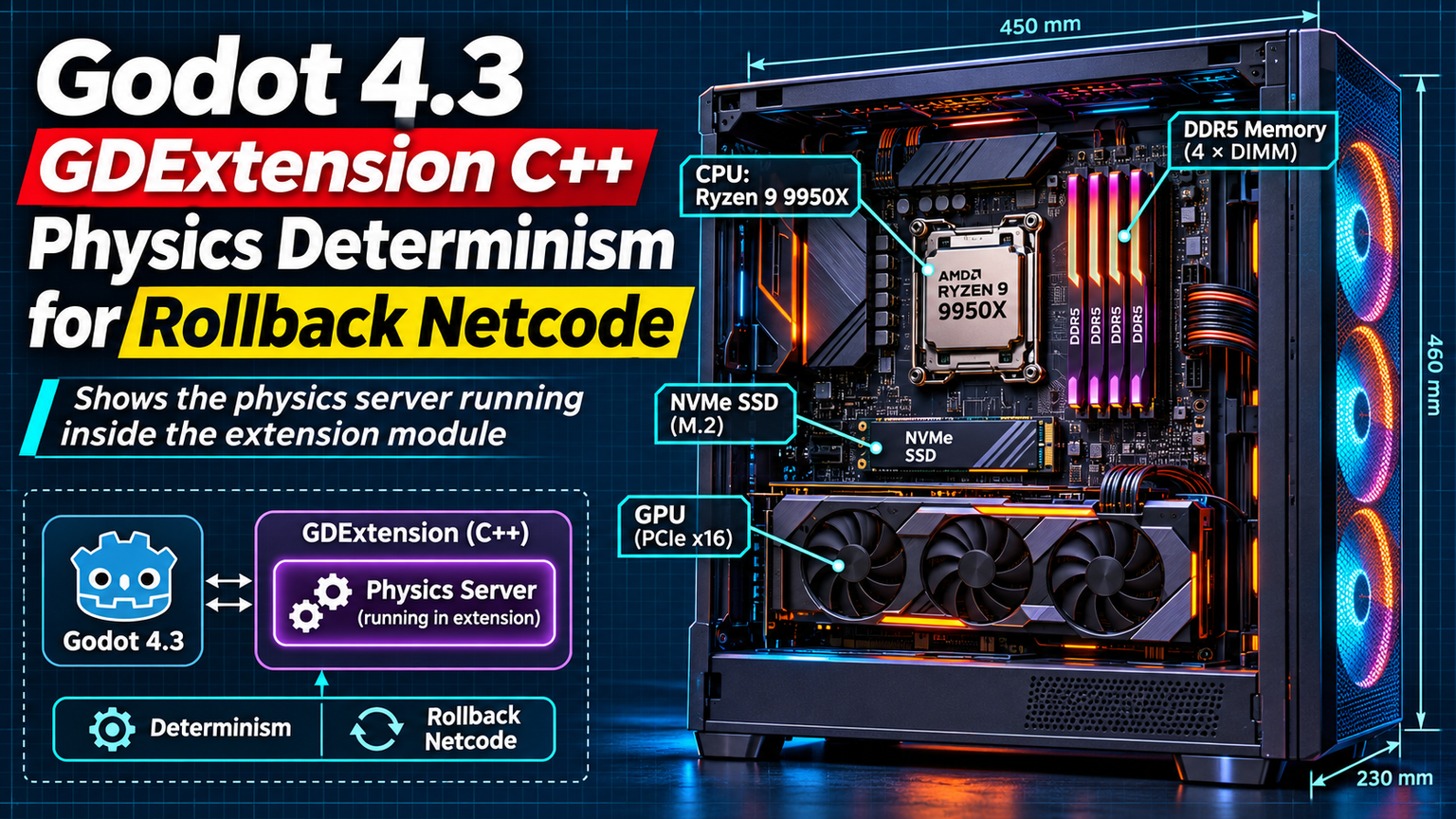
You're building a fighting game in Godot 4.3. Your rollback netcode works locally. Then you test across continents and desyncs explode. The culprit isn't your network code — it's physics non-determinism hiding in plain sight.
Why Physics Breaks Determinism
Godot's built-in PhysicsServer3D uses floating-point math that varies across CPU architectures, compiler optimizations, and even runtime states. A single frame's physics step on x86_64 produces different results than ARM64. For rollback netcode, where every peer must simulate identical frames from identical inputs, this variance is fatal.
"Determinism isn't a feature you add later. It's a constraint you design for from the first line of physics code.
— Network Physics Engineer
GDExtension: Your Determinism Escape Hatch
GDExtension lets you replace Godot's physics with a C++ implementation using fixed-point arithmetic or deterministic float libraries. You keep the editor workflow, scene tree, and GDScript gameplay code while owning the simulation core.
💡
TipUse libfixmath or boost::multiprecision::cpp_dec_float for fixed-point math. Avoid std::float_t — its precision varies by platform.
Integration Checklist
| Step | Action | Verification |
|---|---|---|
| 1 | Register GDExtension entry point | godot::GDExtensionBinding::InitObject |
| 2 | Override PhysicsServer3D methods | _body_step, _area_step, _shape_cast_motion |
| 3 | Replace ProjectSettings physics/3d/singleton | YourDeterministicPhysicsServer3D |
| 4 | Disable built-in PhysicsServer3D | ProjectSettings -> Physics -> 3d -> Enabled = false |
| 5 | Test cross-platform frame parity | Hash frame state on x86_64 and ARM64 |
Rollback-Specific Patterns
Your deterministic physics server must support snapshot/restore for rollback frames. Implement _body_get_state() returning fixed-point data and _body_set_state() accepting it without side effects. Store the last 64 frames in a ring buffer keyed by frame number.
⚠️
WarningNever call Godot's non-deterministic math functions (sin, cos, sqrt) inside physics steps. Precompute lookup tables or use fixed-point approximations.
Testing Determinism in CI
Add a GitHub Actions matrix testing x86_64 and ARM64 runners. Run a headless Godot instance that simulates 10,000 frames with recorded inputs, then hashes the final world state. The hash must match across architectures.
Ship It
You now own the physics simulation. Your rollback netcode compares frame hashes instead of debugging desyncs. Players in Tokyo and São Paulo experience identical hit detection. The GDExtension boundary keeps your gameplay code in GDScript while the deterministic core runs in C++. Next step: profile the fixed-point overhead — it's usually under 2ms per frame — then optimize collision broadphase for your specific game genre.