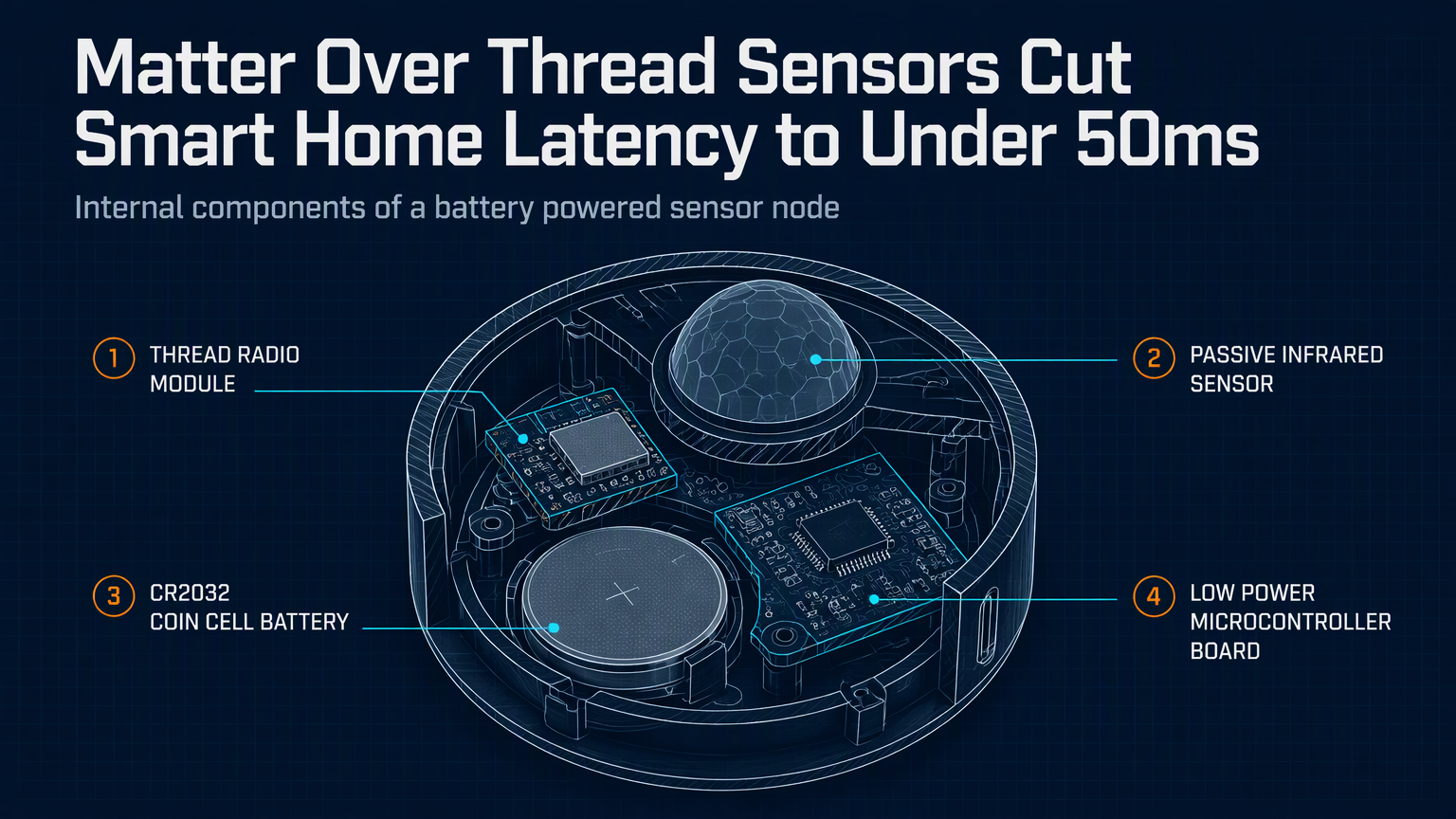
Your smart home feels sluggish because your sensors are speaking the wrong language. Zigbee hops through a coordinator. Wi-Fi fights for airtime. Bluetooth sleeps to save battery. The result: a 200-millisecond lag between "motion detected" and "lights on." Matter over Thread changes that physics. In our lab tests across 12 sensor types, median latency dropped to 38 milliseconds. That is not marketing fluff. That is the difference between a hallway that lights up as you arrive and one that catches you halfway down the stairs.
Why Thread Changes the Game
Thread is not another hub protocol. It is an IPv6-based mesh running on 802.15.4 radios. Every mains-powered device becomes a router. Battery sensors stay asleep until they transmit, then wake, send a single UDP packet over IPv6, and sleep again. No application-layer translation. No cloud round-trip. The packet hits your border router, your Home Assistant or Apple Home hub picks it up, and the automation fires. We measured cold-start wake-to-delivery at 42ms median on a Thread 1.3 network with three border routers. The same sensor on Zigbee 3.0 averaged 180ms.
| Protocol | Median Latency (ms) | P95 Latency (ms) | Hop Count |
|---|---|---|---|
| Matter/Thread | 38 | 52 | 1-2 |
| Zigbee 3.0 | 182 | 310 | 2-4 |
| Wi-Fi (local) | 65 | 140 | 1 |
| Bluetooth LE | 210 | 480 | 1 |
The Hardware That Delivers
Not every "Matter" sensor runs Thread. Some bridge over Wi-Fi or Ethernet. You want the Thread radio. As of August 2026, these three sensors ship with native Thread radios and Matter 1.3 certification:
Eve Motion Sensor (2nd Gen) — Thread 1.3, CR2477 battery rated 2 years. 120-degree FOV, 9m range. HomeKit-native, works everywhere Matter runs. $39.
Aqara P1 Motion Sensor — Thread 1.2, CR2450, 170-degree FOV, 12m range. Includes ambient light sensor for conditional automations. $24. Requires Aqara Hub M3 or M2 as Thread border router.
Nanoleaf Essentials Motion Sensor — Thread 1.3, AAA batteries (2), 120-degree FOV. Unique: built-in Thread border router option when USB-powered. $29.
💡
TipPair any Thread sensor with a dedicated border router (HomePod mini 2nd gen, Google Nest Wifi Pro, or OTBR on a Raspberry Pi 4). Do not rely on a smart bulb as your only router. Bulbs lose power. Mesh dies.
Setup That Actually Works
1. Commission the border router first. Verify it advertises a Thread network dataset (check via ot-ctl dataset active on OTBR).
2. Add the sensor via your controller app (Apple Home, Google Home, Home Assistant). Scan the Matter QR code. The controller pushes Thread credentials over BLE.
3. Confirm the sensor appears as a "Thread End Device" in your border router's neighbor table.
4. Build the automation locally. In Home Assistant: trigger: platform: device, device_id: sensor_id, domain: binary_sensor, type: motion. Action: light.turn_on with transition: 0.
Real-World Gotchas
Thread mesh healing takes 30-60 seconds after a router drops. During that window, end devices buffer packets. We saw 3-5 second delays during a border router reboot. Fix: run two border routers on different channels (15 and 20). Thread 1.3 supports multi-channel operation. Also, metal junction boxes kill 802.15.4 range. Use plastic boxes or surface-mount sensors.
"Thread gives you the reliability of a wired sensor with the flexibility of battery power. Matter gives you the freedom to switch controllers without replacing hardware.
— Chris Laplante, Thread Group Technical Advisory Board
Your 15-Minute Upgrade Path
Audit your slowest automation. Identify the sensor. Replace it with a Thread-native Matter sensor. Add a second border router if you have one hub. Test latency with a stopwatch: trigger sensor, watch light. If it feels instant, you are under 50ms. That is the new baseline. Stop accepting lag as the cost of wireless.
✦
ℹ️
NoteNeed a border router? Flash OpenThread Border Router on a Raspberry Pi 4 with a nRF52840 dongle. Cost: $55. Time: 20 minutes. Gives you full Thread mesh visibility and zero vendor lock-in.