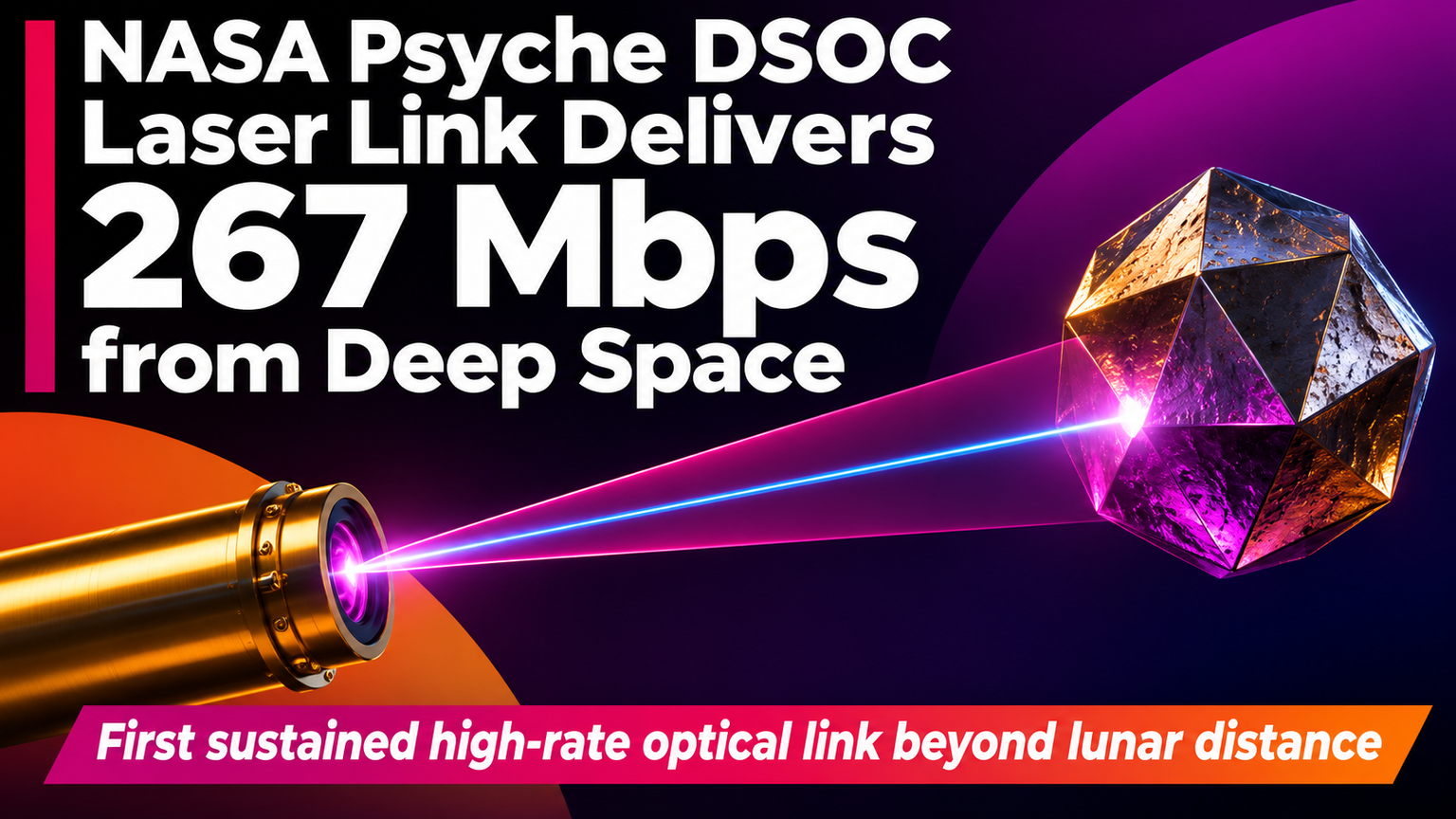
NASA's Deep Space Optical Communications (DSOC) experiment aboard the Psyche spacecraft just shattered records, beaming data at 267 megabits per second from 140 million miles away. That's not a typo. It's a paradigm shift for deep space exploration.
The Breakdown
On April 8, 2024, DSOC's flight laser transceiver locked onto the Hale Telescope at Caltech's Palomar Observatory. The downlink hit 267 Mbps. For context, that's faster than many home broadband connections—from a spacecraft 1.5 times the Earth-Sun distance. The previous deep space radio record? Roughly 6 Mbps from the Mars Reconnaissance Orbiter, and only at much closer range.
"Optical communication is a boon for scientists and researchers who want ever more from their space missions, and will enable human exploration of deep space.
— Dr. Jason Mitchell, NASA SCaN Program
Why Lasers Beat Radio
Radio waves spread out. By the time a Ka-band signal reaches Earth from Mars, its beam is wider than the planet. Lasers diverge minimally. DSOC's 4-watt near-infrared laser delivers photons into a tight cone, concentrating energy where it counts: the receiver aperture.
| Metric | Radio (Ka-band) | DSOC Optical | |
|---|---|---|---|
| Frequency | 32 GHz | 281 THz (1064 nm) | |
| Beam Divergence | ~0.1 deg | ~4 µrad | |
| Typical Data Rate (Mars) | 6 Mbps | 100+ Mbps (projected) | |
| Aperture Needed (Earth) | 70 m | 5–10 m |
💡
TipDSOC uses photon-counting detectors (superconducting nanowires) cooled to <1 Kelvin. Each detected photon carries ~log2(M) bits via pulse-position modulation (M=256 typical).
The Pointing Challenge
Hitting a 10-meter target from 225 million km requires 4-microdegree stability. Psyche's attitude control isn't that precise. DSOC solves this with a vibration-isolated platform and a fast-steering mirror that corrects jitter at 1 kHz. The ground uplink beacon (a 5-kW laser from Table Mountain) gives the transceiver a reference to point back.
What This Unlocks
High-definition video from Mars. Real-time telemetry from Europa landers. Crewed missions with 4K comms. DSOC proves the physics; now engineering scales it. NASA's TBIRD CubeSat already hit 200 Gbps from LEO. The Deep Space Network is adding optical apertures to its 34-meter dishes. Hybrid RF/optical terminals are the near-term standard.
ℹ️
NoteDSOC is a tech demo, not Psyche's primary comms. The mission still relies on X-band for commanding and safing. Optical is bonus science bandwidth.
Next Steps for Engineers
If you're designing deep space comms: start trading RF for optical in your link budgets. Model atmospheric loss (clouds kill optical). Plan for ground station diversity (multiple sites for weather). Implement adaptive data rates—DSOC drops to 62.5 Mbps when range doubles. And budget for cryocoolers; those SNSPDs don't run warm.
✦
The 267 Mbps demo isn't the ceiling. It's the floor. As apertures grow and coding gains improve, gigabit deep space links become routine. The bottleneck shifts from physics to ground infrastructure. Build the telescopes. The photons are waiting.