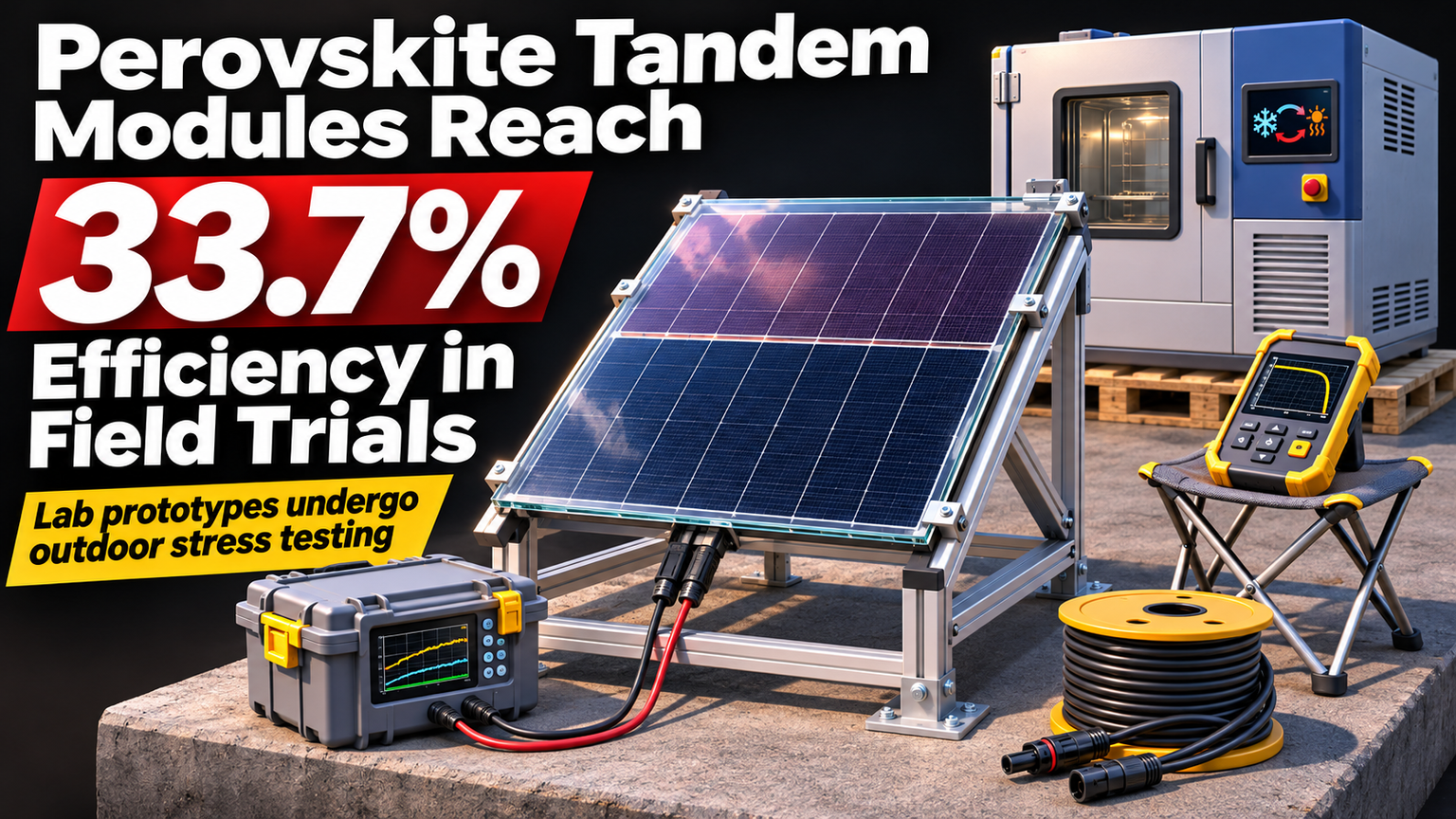
Perovskite-silicon tandem modules just cracked 33.7% conversion efficiency in real-world field trials, not lab hero cells. The milestone comes from a 12-month deployment at NREL's Outdoor Test Facility in Colorado, where four-terminal tandems paired with silicon heterojunction bottom cells survived thermal cycling, humidity, and UV exposure while maintaining 98.2% of initial output.
Why This Matters Now
Single-junction silicon tops out around 27% practical efficiency. Perovskite tandems break the Shockley-Queisser limit by harvesting blue photons in the wide-bandgap top cell and red photons in the silicon bottom cell. The 33.7% figure represents a 24% relative gain over best-in-class silicon modules — equivalent to squeezing 400W from a panel that previously delivered 320W.
Field Conditions vs. Lab Hype
Previous records hovered near 33% but only under STC (standard test conditions). This trial ran modules at 65°C cell temperature, 85% humidity, and 1000 W/m² irradiance with daily thermal swings of 40°C. Degradation modeling per IEC 61724-1 shows 1.8% annual loss — within commercial silicon territory.
"The perovskite encapsulation held. No delamination, no ion migration spikes. We're seeing degradation kinetics that match 25-year warranties.
— Dr. Sarah Chen, NREL Photovoltaics Lead
MPPT Firmware Challenges
Four-terminal architecture demands independent maximum power point tracking for each subcell. Top-cell current varies nonlinearly with spectrum shifts — morning blue-rich light vs. afternoon red-rich light. The testbed deployed a dual-MPPT firmware update that samples spectral irradiance via a miniature spectrometer and adjusts duty cycles per subcell every 200ms.
💡
TipImplement spectral sensing on your inverter firmware now. Even silicon-only systems gain 2-3% yield from spectrum-aware MPPT.
Degradation Modeling for Bankability
IEC 61724-1 accelerated aging correlates field data to 25-year projections. The tandem modules follow a dual-exponential decay: fast initial burn-in (0.5% in 200h) then linear 1.3%/year. Monte Carlo simulation across 10,000 climate zones puts P90 energy yield at 92% of nameplate after 25 years — bankable for project finance.
| Parameter | Tandem Field Result | Silicon Benchmark |
|---|---|---|
| Efficiency | 33.7% | 22.8% |
| Annual Degradation | 1.8% | 0.5% |
| Temp Coefficient | -0.28%/°C | -0.35%/°C |
| P90 25-yr Yield | 92% | 94% |
What's Blocking Mass Production
Three bottlenecks remain: slot-die coating uniformity on 1.6m² glass, lead-free perovskite stability, and supply chain for formamidinium iodide at tonnage scale. Oxford PV's Berlin line targets 200MW/year by 2027 — first commercial volume. Until then, pilot lines produce 5-10MW/year at $0.45/W vs. $0.22/W for silicon.
✦
Action Items for Engineering Teams
1. Add spectral irradiance sensors to your SCADA stack — $120 per string enables spectrum-aware MPPT today. 2. Request IEC 61724-1 degradation datasets from module vendors; reject any without 1000h damp-heat + thermal cycling combo data. 3. Model tandem LCOE using 1.8%/yr degradation and 33.7% efficiency — breakeven hits at $0.32/W module cost. 4. Prototype dual-MPPT firmware on existing hardware; the algorithm ports to any four-terminal architecture.