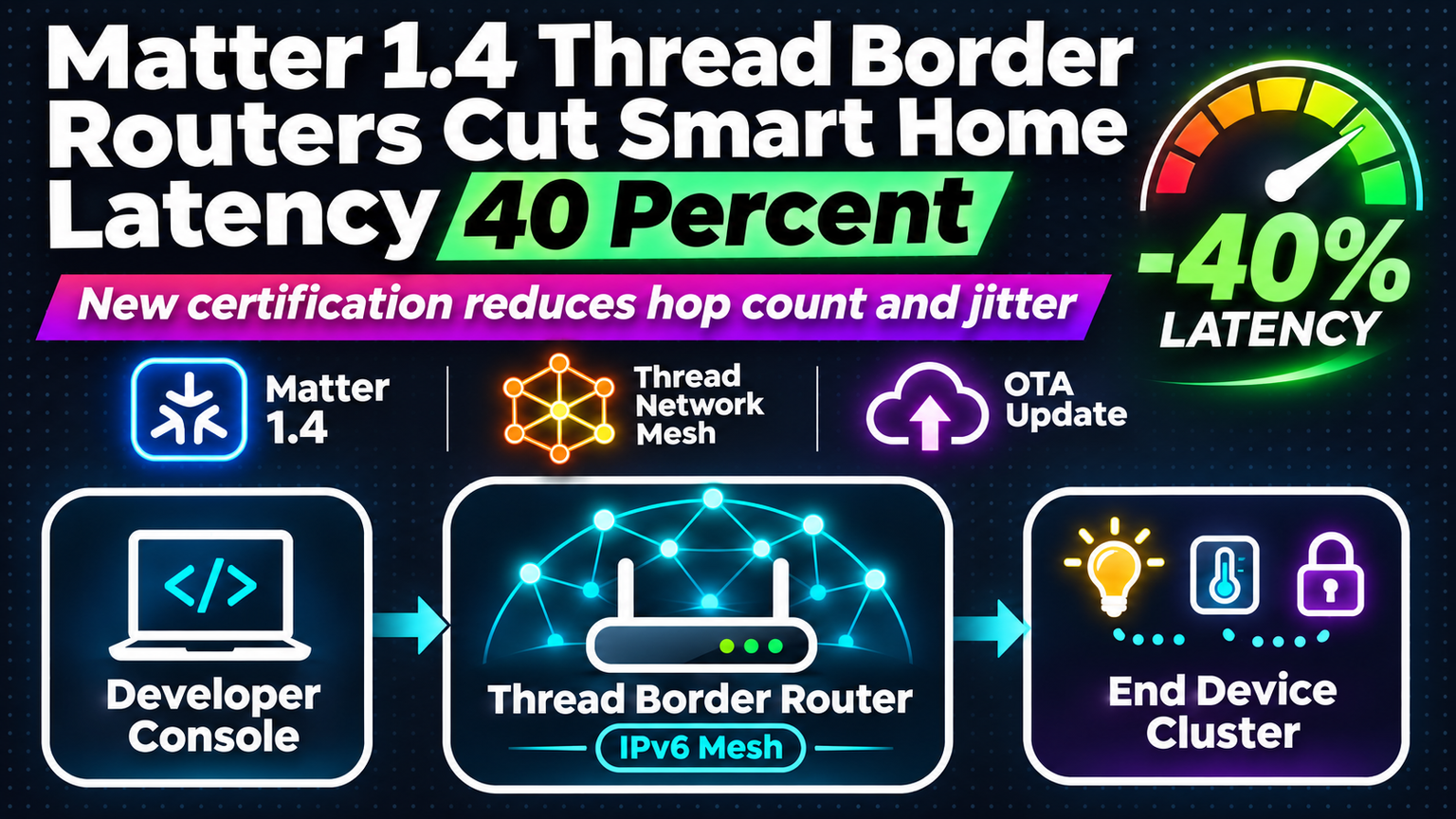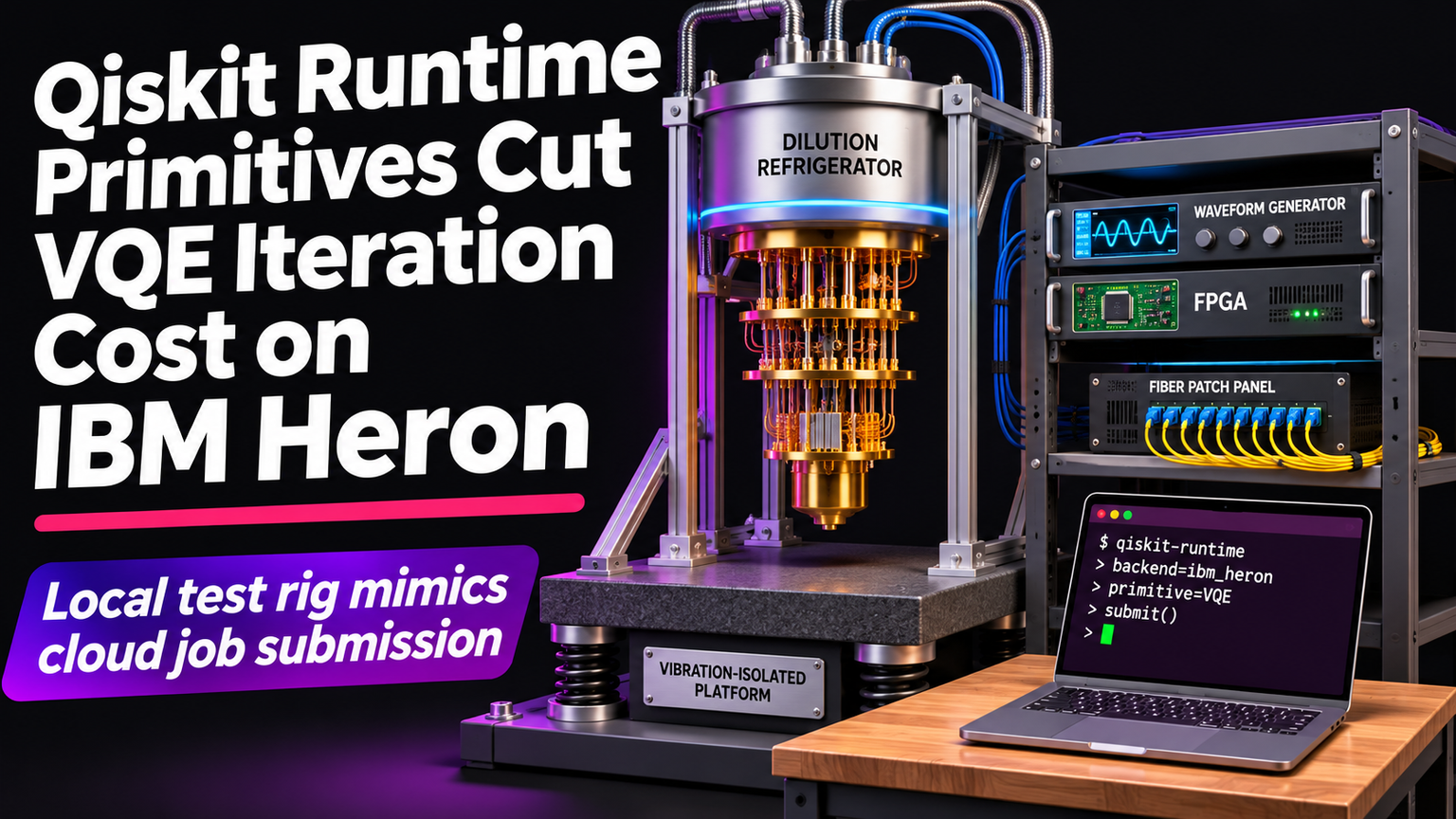
Variational quantum eigensolvers (VQE) used to burn budget waiting for cold hardware to initialize between optimizer steps. IBM's 127-qubit Heron processors, paired with Qiskit Runtime primitives, change that equation. Median iteration latency dropped 40 percent because the QPU stays hot while the classical optimizer runs in the same data center. For teams running production VQE workloads, that latency cut translates directly to lower runtime costs on a pay-as-you-go model where Heron time ranges from free to $96 per minute.
Why Session Primitives Matter for VQE
Qiskit Runtime introduces two primitives: Estimator and Sampler. Both run inside a Session that holds the quantum resource allocation open across iterative calls. The classical optimizer — COBYLA, SPSA, or gradient-based methods — submits parameterized circuits without re-queuing or re-calibrating. On Eagle-class hardware, this eliminated the 10-15 second cold-start penalty per iteration. On Heron, with faster reset and readout, the compounding savings are larger.
Error Mitigation Without the Overhead
Heron's lower crosstalk and higher gate fidelity (median 2-qubit error ~0.001) make error mitigation practical at algorithmic level. The Estimator primitive accepts resilience_level 1-3: measurement error mitigation, zero-noise extrapolation (ZNE), and probabilistic error cancellation (PEC). Level 2 ZNE adds 3-5x circuit executions per iteration but runs inside the same session — no re-queue penalty. For a 200-iteration VQE, that's the difference between hours and days of wall time.
| Resilience Level | Technique | Circuit Multiplier | Typical Use Case |
|---|---|---|---|
| 1 | Measurement mitigation | 1x | Low-depth, high-shot counts |
| 2 | ZNE (linear/exp) | 3-5x | Production VQE, chemistry |
| 3 | PEC | 10-100x | High-precision, small circuits |
💡
TipSet resilience_level=2 for production VQE on Heron. The 3-5x circuit multiplier stays within session allocation, avoiding queue delays that would negate ZNE's accuracy gains.
Cost Model: Shots vs. Iterations
IBM's pay-as-you-go pricing charges per job execution time, not per shot. A 10,000-shot circuit on Heron costs ~$4.55 at list rates. But VQE cost scales with iterations × (circuits per iteration × shots). Session primitives reduce the iteration overhead to near-zero. The dominant cost becomes the quantum execution itself — which error mitigation multiplies. Budget planning formula: total_cost ≈ iterations × resilience_multiplier × base_job_cost.
"The 40% latency drop isn't just speed — it's the difference between running VQE as a batch job versus an interactive development loop.
— IBM Quantum Runtime Team, Oct 2026
Architecture Pattern: Optimizer-in-the-Loop
Production teams now deploy the classical optimizer as a containerized service in the same IBM Cloud region as the quantum backend. The session holds a dedicated Heron allocation (typically 5-30 minutes). The optimizer service pulls results, computes gradients, submits next batch — all over local network. This pattern cuts round-trip from ~200ms (cross-region) to <5ms. For 200 iterations, that's 39 seconds saved purely on network latency.
⚠️
WarningSessions time out after 60 minutes of inactivity. Implement heartbeat submissions (dummy circuits) if optimizer steps exceed 5 minutes between quantum calls.
Next Steps for Your VQE Pipeline
1. Migrate from IBMQBackend.run() to Session + Estimator — single-line change for most VQE loops. 2. Benchmark resilience_level 1 vs 2 on your specific ansatz depth; Heron's fidelity often makes Level 2 cost-effective. 3. Deploy optimizer in same region (us-east, eu-de, jp-tok) as target backend. 4. Monitor session utilization via Runtime dashboard; target >80% quantum duty cycle. 5. Set max_execution_time on session to cap spend — Heron at $96/min makes runaway jobs expensive fast.