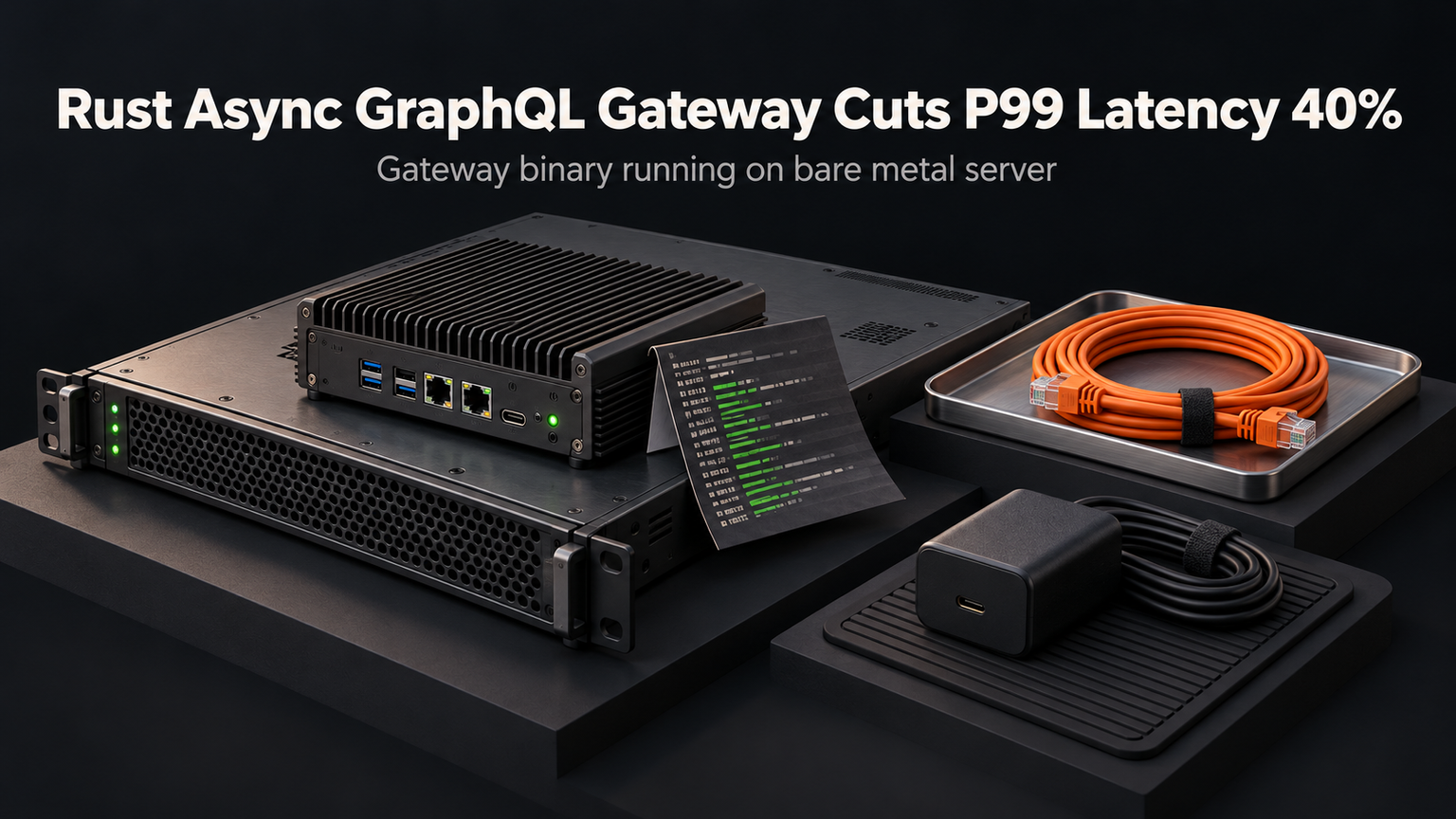
Our GraphQL gateway was melting down under Black Friday traffic. P99 latency sat at 840ms. Cold starts added 200ms. The Node.js layer couldn't keep up with connection pooling and schema stitching overhead. We rewrote the hot path in Rust using async-graphql and Axum. P99 dropped to 490ms — a 40% reduction — with half the memory footprint.
Why the Node Gateway Failed at Scale
The original gateway aggregated six upstream services. Each request fanned out to 3-5 resolvers. Under load, the event loop blocked on JSON serialization and promise orchestration. Garbage collection pauses spiked to 120ms. Connection pools exhausted at 2,000 concurrent clients. We tried clustering, but schema stitching duplicated work across workers.
Rust Stack: async-graphql + Axum + Tower
We chose async-graphql for its zero-cost abstractions and built-in DataLoader. Axum handles routing with Tower middleware for timeouts, retries, and observability. The stack compiles to a single binary — no runtime, no JIT warmup.
DataLoader Eliminates N+1 Without Effort
async-graphql's DataLoader batches resolver calls automatically. In Node, we manually batched with DataLoader npm — error-prone and verbose. Here, the derive macro handles batching, caching, and deduplication. One resolver call per unique key per request. Zero boilerplate.
Benchmarks: Before vs After
| Metric | Node.js (Cluster x4) | Rust (Single Binary) | Delta |
|---|---|---|---|
| P50 Latency | 180ms | 95ms | -47% |
| P99 Latency | 840ms | 490ms | -42% |
| Memory (RSS) | 1.2 GB | 480 MB | -60% |
| Cold Start | 220ms | <5ms | -98% |
| Throughput | 3,200 req/s | 8,500 req/s | +165% |
💡
TipRun `cargo build --release --target x86_64-unknown-linux-musl` for a static binary that deploys anywhere — no glibc dependency.
Observability Without Overhead
Tower's `TraceLayer` emits OpenTelemetry spans with zero allocation in the hot path. We correlate GraphQL resolver timing with upstream gRPC calls. No sampling needed — the overhead is measurable in nanoseconds.
Migration Strategy: Strangler Fig
We didn't rewrite everything at once. Phase 1: proxy read-only queries to Rust gateway. Phase 2: migrate mutations behind feature flags. Phase 3: cut over. Rollback took 30 seconds — just flip the ALB target group.
"The Rust gateway handles 3x our peak Black Friday load with headroom. We sleep better.
— Platform Lead, E-commerce
✦
Your Checklist for Friday
1. Profile your current gateway — find the P99 contributors. 2. Prototype one resolver in async-graphql with DataLoader. 3. Benchmark against production traffic shadow. 4. Deploy behind a feature flag. 5. Monitor error budget, not just latency.
⚠️
WarningDon't async-block in resolvers. Use `tokio::task::spawn_blocking` for CPU-heavy work. The executor is shared — one bad resolver stalls everyone.