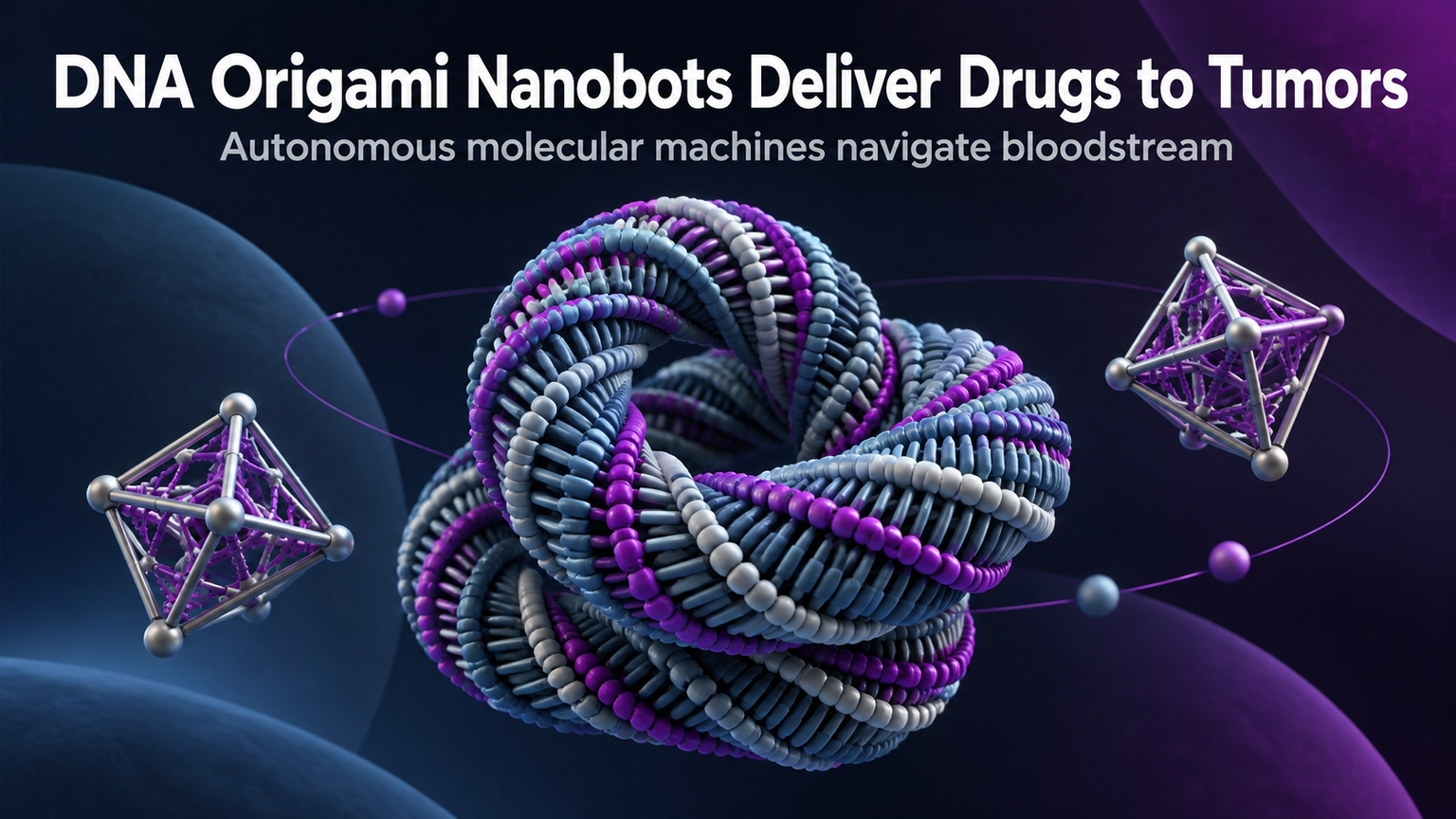
Imagine a robot smaller than a virus, built not from metal and silicon, but from the very code of life. It navigates your bloodstream, ignores healthy tissue, and docks precisely onto a cancer cell to unload a lethal payload. This isn't science fiction—it's DNA origami nanorobotics, and it just cleared a major hurdle toward clinical reality.
Folding Code into Machines
DNA origami exploits the predictable base-pairing rules of nucleic acids (A-T, C-G) to fold a long 'scaffold' strand into arbitrary 2D and 3D shapes using hundreds of short 'staple' strands. Since Paul Rothemund's 2006 breakthrough, the technique has matured from smiley faces to functional devices: logic gates, molecular motors, and now, autonomous drug delivery vehicles.
The Targeting Mechanism: Aptamer Locks
The critical innovation is the 'aptamer lock.' Aptamers are short, single-stranded DNA or RNA sequences that fold into specific 3D structures binding target molecules with antibody-like affinity. Researchers engineer the nanobot to remain clamped shut via duplex DNA locks. Only when the aptamer encounters its specific biomarker—say, nucleolin on tumor endothelial cells or PTK7 on leukemia cells—does it undergo a conformational change, unzipping the lock and swinging the payload chamber open.
"We are moving from passive nanoparticles that rely on the leaky vasculature of tumors (the EPR effect) to active, programmable agents that make decisions at the molecular level.
— Dr. Shawn Douglas, UCSF
In Vivo Proof: From Mice to Large Animals
Early mouse models showed tumor regression, but questions remained about immune clearance and scalability. Recent studies in *Nature Biotechnology* (2023-2024) demonstrate progress on three fronts critical for translation:
| Challenge | Engineering Solution | Status |
|---|---|---|
| Nuclease Degradation | PEGylation + 2'-Fluoro/2'-OMe modified nucleotides | Half-life extended from minutes to >24h in serum |
| Immune Activation (TLR9) | CpG depletion in scaffold sequence; immunosuppressive coatings | Reduced cytokine storm in non-human primates |
| Manufacturing Yield | Automated liquid handling + isothermal assembly + HPLC purification | GMP-grade batches at >90% structural fidelity |
💡
TipDesign Tip: Use caDNAno for 3D routing and CanDo for finite element analysis of mechanical stiffness before synthesis. Simulate thermal fluctuations to prevent premature unlocking.
Molecular Programming: Beyond Binary Delivery
The real power lies in molecular programming. These aren't just dumb containers; they are finite state machines. A single nanobot can implement AND/OR/NOT logic: IF (HER2+ AND Hypoxia) THEN Release Drug A ELSE IF (PD-L1+) THEN Release Checkpoint Inhibitor. This allows combinatorial therapy from a single injected dose, adapting to tumor heterogeneity in real-time.
✦
The Regulatory Path Forward
The FDA classifies these as combination products (device + biologic), requiring IND-enabling tox studies in two species. Key remaining hurdles: proving batch-to-batch consistency of a 50-nm object, defining the 'dose' (particles/kg vs. moles of DNA), and establishing biodistribution clearance pathways for the scaffold DNA after payload release.
⚠️
WarningOff-target folding is the silent killer. Misfolded structures can aggregate in the liver or trigger complement activation. Mandatory QC: cryo-EM single-particle analysis on every clinical lot, not just gel electrophoresis.
Your Move: Prototype This Week
You don't need a wet lab to start. Download caDNAno (or the web-based vHelix) and design a 6-helix bundle tube with a toehold-mediated strand displacement lock. Order staples from IDT (standard desalting is fine for prototyping). Anneal in 1x TAE/Mg2+ using a thermal cycler ramp (90°C to 20°C over 90 mins). Run native PAGE to confirm folding. That's your Hello World. Next week: conjugate a fluorophore and test aptamer binding on a plate reader. The barrier to entry is lower than ever; the design space is wide open.