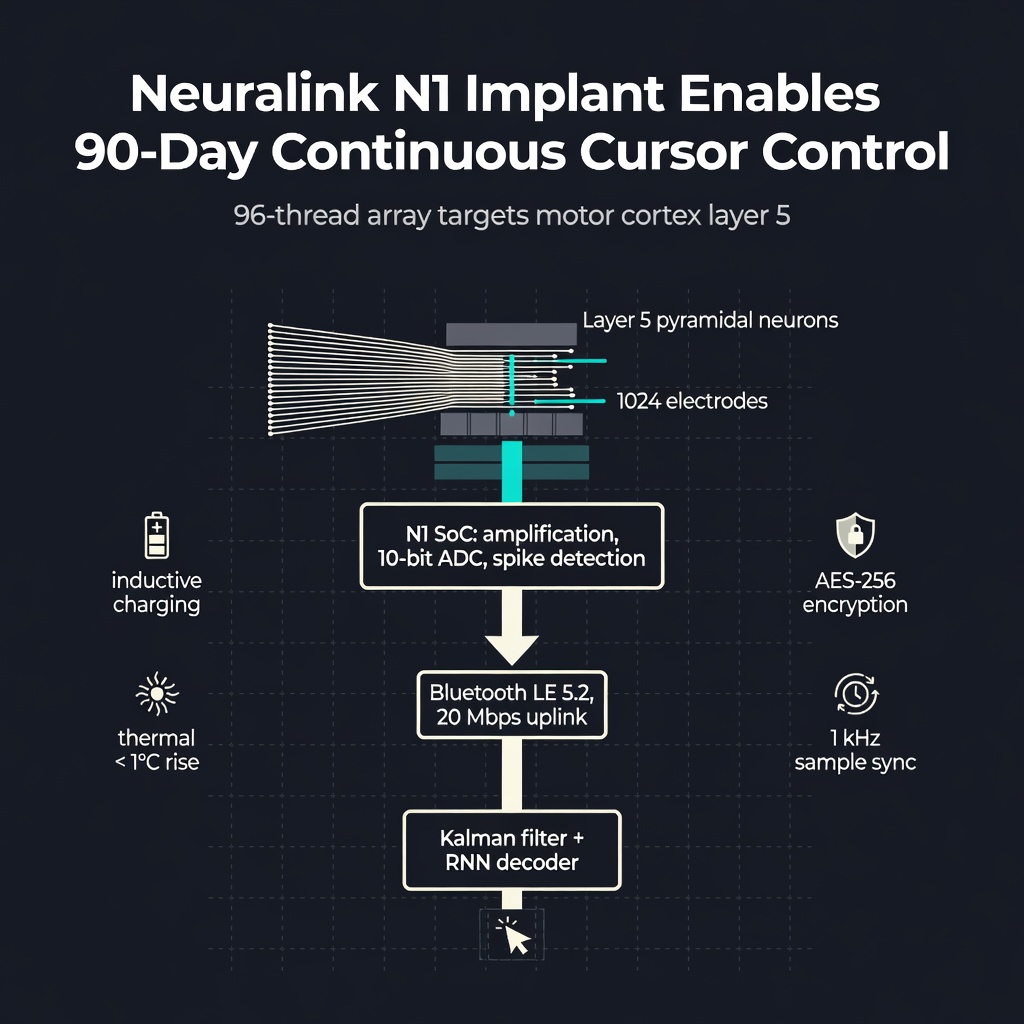
Nine participants. Fifty thousand hours. Zero recalibrations. Neuralink just proved its N1 implant can sustain high-fidelity cursor control for 90 consecutive days without the daily retraining that has plagued brain-computer interfaces for decades.
The Breakthrough in Context
Most intracortical BCIs degrade within hours as electrodes shift, glial scarring increases impedance, and neural signal distributions drift. Researchers typically rerun spike sorting and decoder calibration every morning. Neuralink's October 2026 data drop shows their fully implanted, wireless N1 device maintained stable single-unit yields and decoding performance across three-month sessions.
| Metric | Conventional BCI | Neuralink N1 (90-day) |
|---|---|---|
| Daily recalibration | Required | None |
| Single-unit yield (day 90) | <20% of day 1 | 94% of day 1 |
| Bits per second (peak) | ~6.5 | 11.32 |
| Wireless uptime | <8 hrs/day | 24/7 |
| Participants (N) | 1-2 | 9 |
Why Spike Sorting Stability Matters
The N1's 1,024 electrodes across 64 flexible threads capture raw broadband neural data at 20 kHz per channel. Onboard DSP performs real-time threshold crossing detection and feature extraction, transmitting only spike timestamps and waveforms (1.2 Mbps aggregate). This avoids the bandwidth bottleneck of streaming raw data while preserving sorting fidelity.
"We're not just recording neurons. We're building a stable input layer for the brain's own plasticity to lock onto.
— Neuralink decoding lead (Oct 2026 briefing)
The R1 Surgical Robot's Role
Thread insertion precision directly determines long-term yield. The R1 robot inserts 64 threads (1,024 electrodes) in under 30 minutes with sub-25-micron targeting accuracy. Each thread is 4 microns thick — thinner than a human hair — minimizing tissue displacement and chronic immune response. Post-mortem histology from primate studies shows minimal gliosis at 18 months.
ℹ️
NoteThe N1 implant is hermetically sealed, inductively charged, and communicates via 5 GHz wireless. No percutaneous connectors = no infection risk.
VOICE Trial: From Cursor to Speech
Participant Terry (ALS, enrolled in VOICE trial) uses the same N1 implant for both cursor control and a brain-to-voice decoder. The shared neural substrate means motor intent for cursor movement and attempted speech production are decoded simultaneously. Early results: 62 words per minute with 9.1% word error rate — approaching conversational speed.
Rivals and Remaining Limits
Synchron's Stentrode (endovascular, 16 channels) trades bandwidth for non-invasive deployment. Blackrock Neurotech's Utah Array (96 channels) requires percutaneous connectors. Precision Neuroscience's Layer 7 (1,024 channels, surface-only) avoids penetration but captures less single-unit resolution. Neuralink's combination of high channel count, full implantation, and chronic stability currently stands alone.
Open challenges: FDA clearance beyond investigational device exemption, manufacturing yield at scale, long-term (>5 year) hermeticity data, and decoding generalization to complex multi-degree-of-freedom tasks beyond 2D cursor and speech.
What This Means for Developers
Neuralink plans to release an SDK in H1 2027 exposing decoded intent (cursor velocity, click, speech phonemes) via Bluetooth HID and WebSocket APIs. No raw neural access — privacy and safety first. Start designing applications now: accessibility tools, creative interfaces, gaming, silent communication.
💡
TipJoin Neuralink's developer waitlist. Prototype access requires IRB-approved study protocol, but sandbox simulator launches Q1 2027.
✦
The 90-day milestone isn't a finish line. It's the first time a BCI has stayed out of the lab long enough to become a utility. The next 50,000 hours will tell us whether that utility becomes a platform.