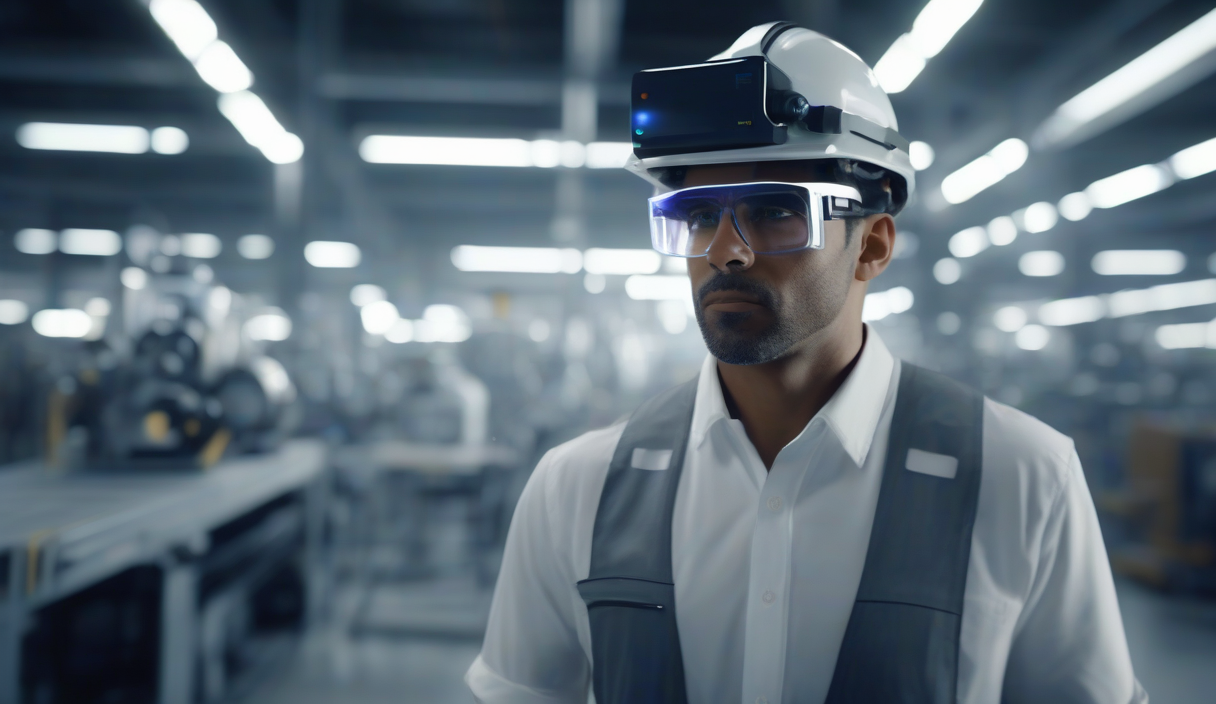
Augmented reality has crossed the threshold from novelty to necessity. In 2024, the global AR market is accelerating toward a projected $599 billion valuation, driven by hardware maturation, AI integration, and enterprise adoption that finally matches the hype. The immersive revolution isn't coming—it's already reshaping how we work, shop, and interact with the physical world.
AR Glasses Finally Get Real
The form factor war has a new front-runner: lightweight, all-day wearables. Meta's Orion prototype, Apple's Vision Pro ecosystem expansion, and Xreal's consumer-ready Air 2 Ultra signal a shift from bulky headsets to glasses that resemble standard eyewear. Micro-OLED displays now hit 3,000+ nits brightness for outdoor visibility, while silicon-anode batteries enable 6+ hour runtime in sub-80g frames. The killer feature? Neural wristbands and eye-tracking that replace controllers entirely.
💡
TipDevelopers: Start building for gesture-first UIs now. The controller paradigm is dying; spatial input via hand/eye tracking is the new baseline.
Spatial Computing Becomes Infrastructure
Spatial computing has graduated from buzzword to OS-layer primitive. Apple's visionOS 2, Android XR, and Niantic's Visual Positioning System (VPS) now anchor persistent digital content to physical coordinates with centimeter accuracy. This enables shared AR experiences—multiplayer gaming, collaborative design, remote assistance—without QR codes or image targets. The world itself becomes the interface.
"The map is no longer a reference. The map is the medium.
— John Hanke, Niantic CEO
Mixed Reality Blurs the Passthrough Line
High-fidelity color passthrough (12ms latency, 4K per eye) makes 'mixed reality' a viable daily driver. Quest 3 and Vision Pro users now spend 40%+ of headset time in MR mode—virtual monitors overlaid on real desks, 3D models anchored to workshop benches, cooking recipes floating above countertops. The distinction between VR and AR is collapsing into a single spectrum: immersion on demand.
WebAR Removes the App Barrier
WebXR + WebGPU + 8th Wall/Geenee SDKs now deliver native-quality AR in mobile browsers. No installs, no permissions friction, instant load. Brands deploy try-on, product viz, and location-based campaigns via QR codes or NFC tags. Conversion rates jump 2-3x versus app-based flows. The web is finally a first-class AR runtime.
| Metric | Native App | WebAR (2024) |
|---|---|---|
| Avg. Load Time | 15-30 sec | <3 sec |
| Friction Steps | 5-7 | 1-2 |
| Reach (Devices) | iOS/Android subset | All WebXR browsers |
| Update Cycle | App Store review | Instant |
Industrial AR Hits ROI Escape Velocity
Manufacturing, logistics, and field service lead enterprise adoption. Boeing cut wiring harness assembly time by 25% using HoloLens 2 guided workflows. DHL's vision picking boosts warehouse efficiency 15%. Siemens reports 30% faster technician onboarding via remote expert AR calls. The pattern: hands-free, context-aware instructions overlaid on equipment reduce errors and cognitive load. 2024 budgets reflect this—industrial AR spend now exceeds consumer.
ℹ️
NoteKey stat: 68% of manufacturers piloting AR in 2024 plan full deployment by 2026 (PwC). The proof-of-concept phase is over.
AI-Generated 3D Assets Unblock Content
Gaussian splatting, NeRFs, and diffusion models (Meshy, Tripo, CSM) turn text, images, or video into game-ready 3D assets in minutes. This solves AR's historic content bottleneck. Retailers auto-generate product models from catalog photos. Architects sketch massing models from site photos. Creators populate scenes without Blender expertise. The asset pipeline is now generative by default.
Privacy & Trust Frameworks Emerge
Always-on cameras mapping private spaces demand new norms. Apple's 'Personas' opt-in, Meta's 'Eye Tracking Privacy' dashboard, and the XR Association's 2024 guidelines establish baseline consent, data minimization, and on-device processing standards. Regulation follows: EU's AI Act classifies biometric AR data as high-risk; US state laws (BIPA, CCPA) extend to spatial mapping. Compliance is now a product requirement, not afterthought.
✦
Your 2024 AR Action Plan
1. Audit spatial use cases—map workflows where hands-free digital overlay cuts time or error. 2. Prototype in WebAR—validate concepts in browser before native investment. 3. Upskill on visionOS/Android XR—spatial SDKs are the new mobile SDKs. 4. Adopt generative 3D pipelines—slash asset costs 90%+. 5. Bake privacy in from day one—retrofitting trust fails. The companies that treat AR as a computing platform, not a pilot project, will own the next interface paradigm.