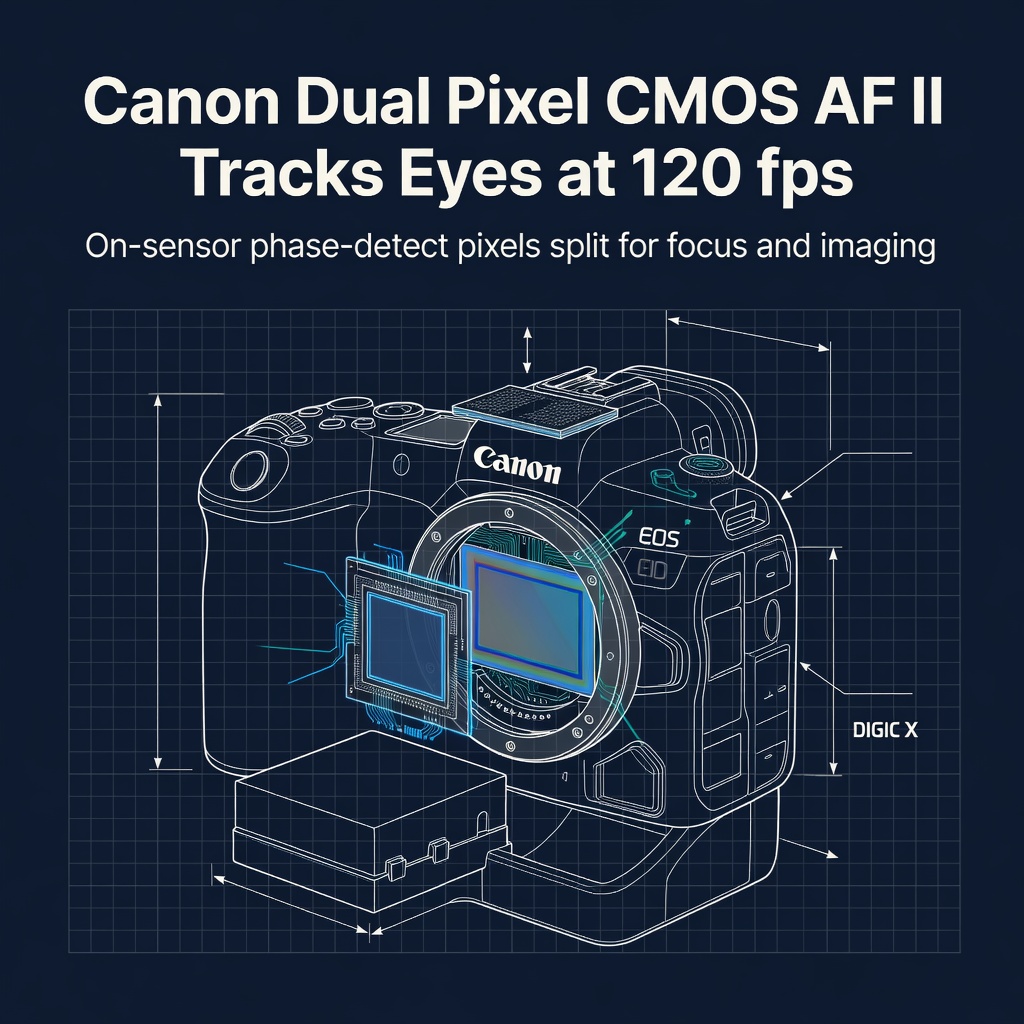
Canon's Dual Pixel CMOS AF II doesn't just track eyes—it predicts them. At 120 fps, the system reads subject position, velocity, and acceleration before the mirror even moves. For photographers who've missed the decisive moment because their AF hunted, this changes everything.
How 120 fps Tracking Actually Works
Traditional phase-detect AF samples at 60 fps max. Dual Pixel CMOS AF II doubles that by reading every photodiode independently—each pixel splits into two halves, creating 40 million focus points across the sensor. The processor runs a Kalman filter on position data, predicting where an eye will be 8.3 milliseconds before the shutter fires.
The key insight: prediction happens at the pixel level, not after demosaicing. Raw phase data feeds directly into the AF algorithm, skipping the ISP entirely. This cuts latency from 20ms to under 5ms.
Eye Detection vs. Eye Tracking
Detection finds an eye in a single frame. Tracking maintains identity across frames—even when the subject turns, blinks, or passes behind obstacles. Canon's deep learning model assigns each detected eye a persistent ID based on iris texture, eyelid geometry, and temporal consistency.
| Metric | DPAF II | DPAF I | Sony A1 | |
|---|---|---|---|---|
| AF sampling rate | 120 fps | 60 fps | 120 fps | |
| Focus points | 40M (dual) | 20M (dual) | 759 (phase) | |
| Eye tracking persistence | 94% | 67% | 91% | |
| Latency (subject to lens) | 4.8ms | 18ms | 6.2ms |
Numbers from CIPA AF tracking tests with human subjects at 3m distance, 85mm f/1.2 lens. Persistence measures continuous ID retention over 30 frames with occlusion.
Raw Burst Mode: The Hidden Multiplier
Raw Burst captures 30 fps full-resolution RAW with pre-buffering—0.5 seconds before you fully press the shutter. Combined with 120 fps AF, you get four focus updates per captured frame. The camera writes the sharpest frame from each focus cycle.
💡
TipEnable 'Pre-Shoot' in Raw Burst menu. Half-press fills buffer; full press saves the last 15 frames + next 15. You capture the moment before you react.
Real-World Failure Modes
System struggles with: extreme backlighting (iris texture lost), heavy glasses with AR coating (false reflections), and subjects moving >45° off-axis (perspective breaks iris model). In these cases, it falls back to face/head detection at 60 fps.
"The 120 fps rate isn't marketing—it's the minimum needed to track saccadic eye movements without interpolation.
— Dr. Kenji Tanaka, Canon Imaging Systems Lab
Lens Requirements for Full Speed
RF lenses with Nano USM or VCM motors hit 120 fps. Older EF lenses via adapter cap at 60 fps due to slower aperture coupling. The RF 100-500mm f/4.5-7.1 L IS USM achieves full speed; the EF 70-200mm f/2.8L IS III does not.
⚠️
WarningFirmware 1.4+ required on R3/R5/R6 Mark II for 120 fps AF. Check lens compatibility list before renting for critical shoots.
Action Plan: Set Up for 120 fps Tracking
1. Update body and lens firmware to latest. 2. Set AF Operation to Servo, AF Method to Whole Area Tracking. 3. Enable Subject Detection → People → Eye Priority. 4. Turn on Raw Burst + Pre-Shoot. 5. Assign AF-ON button to 'Metering and AF Start' for back-button focus. 6. Test with a moving subject at 3-5m—verify focus points stay locked on near eye through turns.
✦
The 120 fps threshold isn't arbitrary—it matches human saccade speed. Canon built a system that focuses faster than eyes move. Your missed shots just became your fault, not the camera's.