Your users just burned through their monthly data plan because your app re-downloaded the entire product catalog every time they opened it. Meanwhile, the backend team is asking why mobile API costs spiked 40% last quarter. The fix isn't better caching — it's stopping the round trips entirely.
Why RxDB + CouchDB Changes the Math
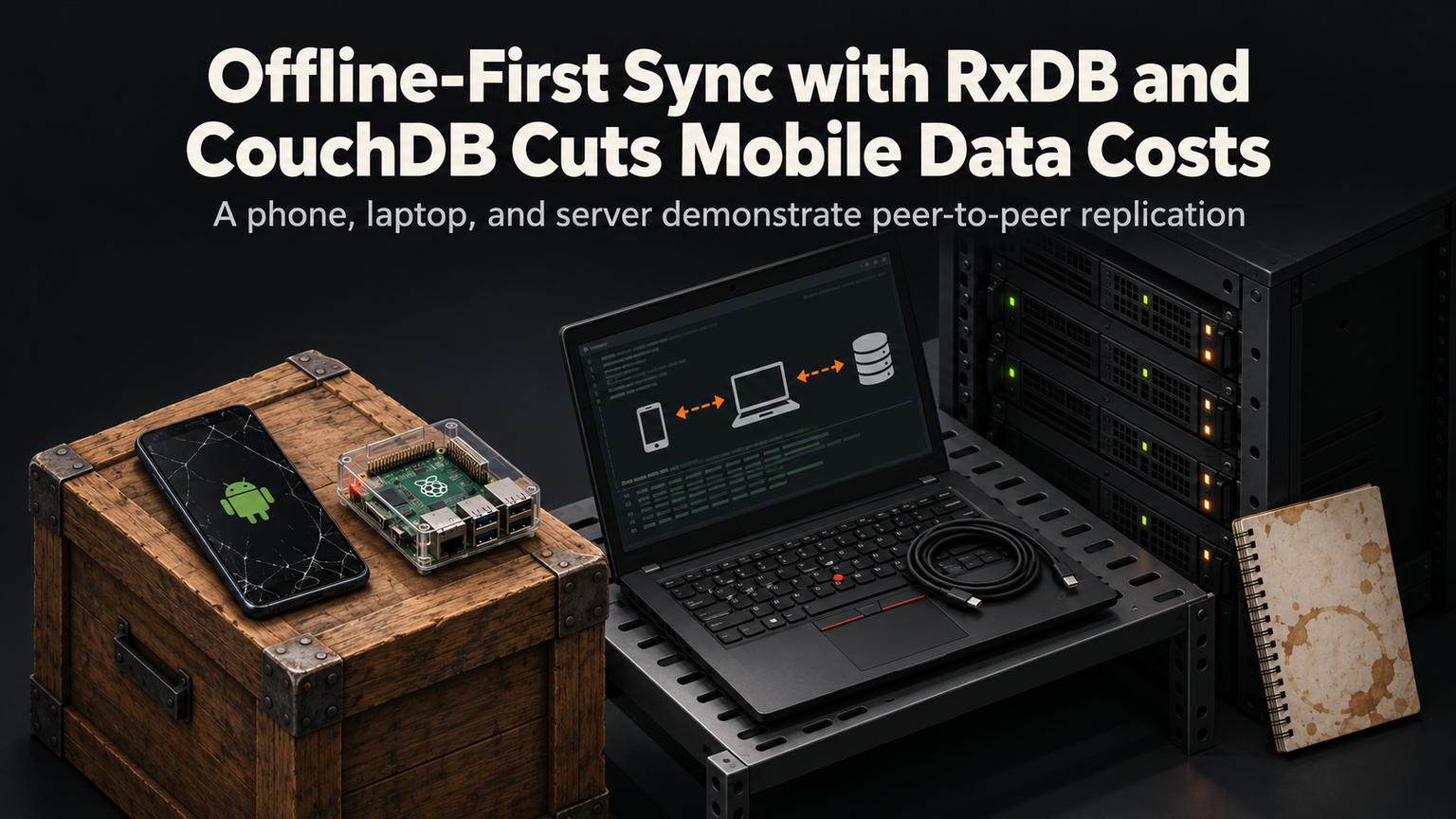
RxDB runs a reactive database inside the browser or React Native bundle. CouchDB speaks the same replication protocol natively. When they talk, only changed documents move across the wire — not full collections, not polling loops, not redundant JSON blobs.
That's the entire sync layer. No custom conflict resolvers, no outbox tables, no background job queues. CouchDB's MVCC revision trees handle conflicts deterministically; RxDB surfaces them as observable conflicts you can resolve in UI if needed.
The Data Cost Breakdown
| Pattern | Avg Payload per Session | Monthly per DAU (10 sessions) |
|---|---|---|
| Full re-fetch (REST) | 2.4 MB | 24 MB |
| Delta polling (5 min) | 600 KB | 6 MB |
| RxDB + CouchDB live sync | 45 KB | 450 KB |
💡
TipEnable CouchDB's _changes feed with filter functions so mobile clients only pull documents matching their user scope — cuts payload another 60-80%.
Offline Writes Without the Headaches
User adds a review on the subway. RxDB writes to IndexedDB instantly. The UI updates reactively. When connectivity returns, the revision replicates to CouchDB. If another user edited the same document, CouchDB flags a conflict — both revisions exist, your app decides the merge.
PWA Service Worker Integration
Register the sync loop in your service worker so replication survives tab close. RxDB's multi-tab support (via BroadcastChannel) means one tab holds the replication connection; others read the same local state.
⚠️
WarningDon't replicate everything. Use CouchDB filtered replication or RxDB's pull/push filters to scope documents per user. Replicating the full database to mobile kills storage and battery.
Production Checklist
Before shipping:
✦
Stop paying for data your users already have. RxDB + CouchDB gives you battle-tested sync with zero custom infrastructure. Your backend bill drops. Your users stay productive offline. The code above runs in production today.