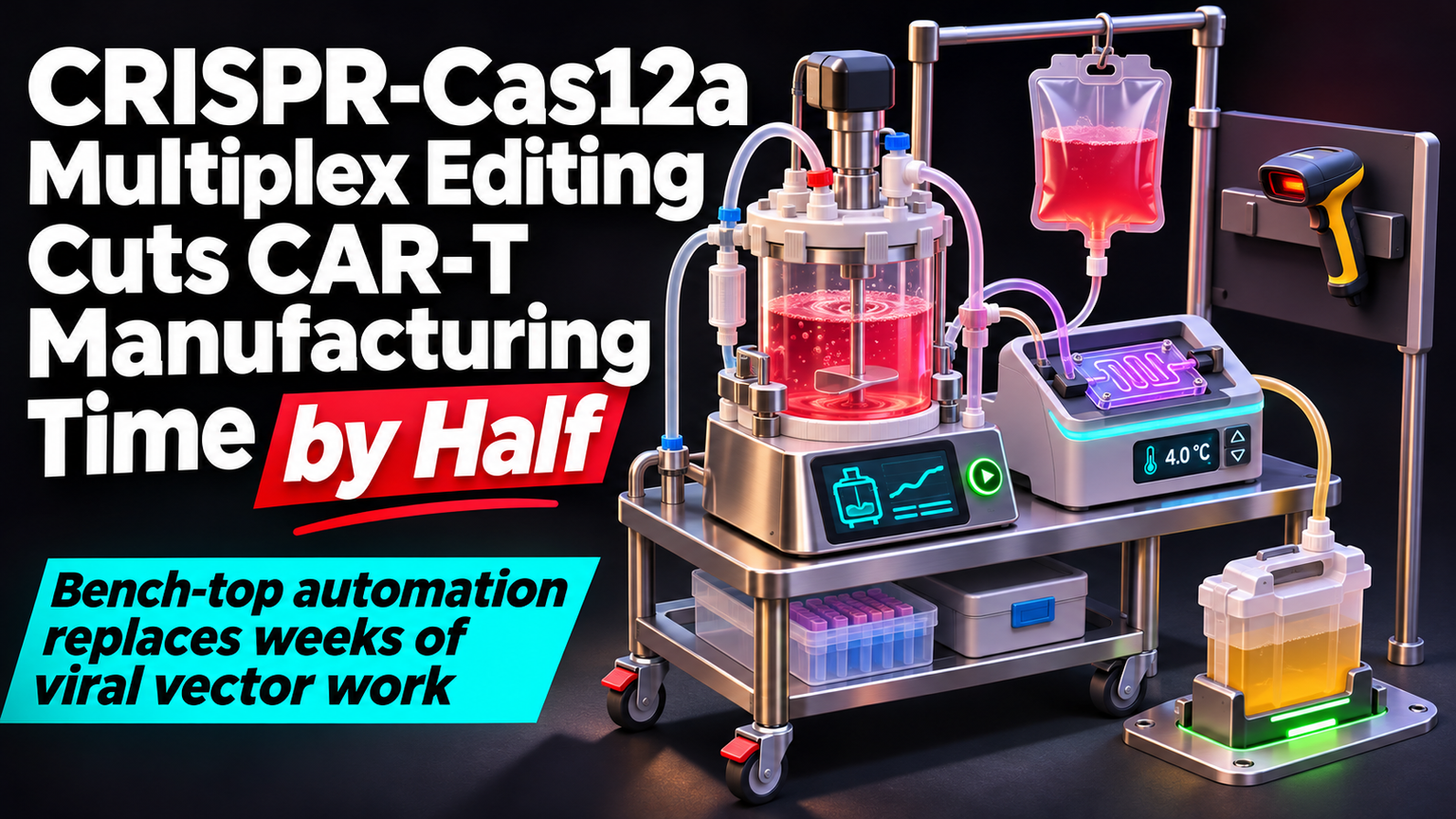
The race to manufacture off-the-shelf CAR-T therapies just hit a new pace. A recent bioprocess breakthrough using CRISPR-Cas12a multiplex editing has slashed allogeneic cell therapy production timelines from weeks to days, potentially unlocking the scale and cost profile the field has chased for a decade.
Why Manufacturing Speed Is the Real Bottleneck
Autologous CAR-T works clinically but fails economically. Harvesting, engineering, expanding, and reinfusing a patient's own T cells takes 3–4 weeks and costs $375K–$475K per dose. Allogeneic “off-the-shelf” products solve the supply side but introduce a new constraint: you must knock out TCR, B2M, and often PD-1 or other checkpoints simultaneously without triggering genomic instability. Sequential editing rounds add weeks of culture time, exhaustion markers, and failure risk.
Cas12a Changes the Math
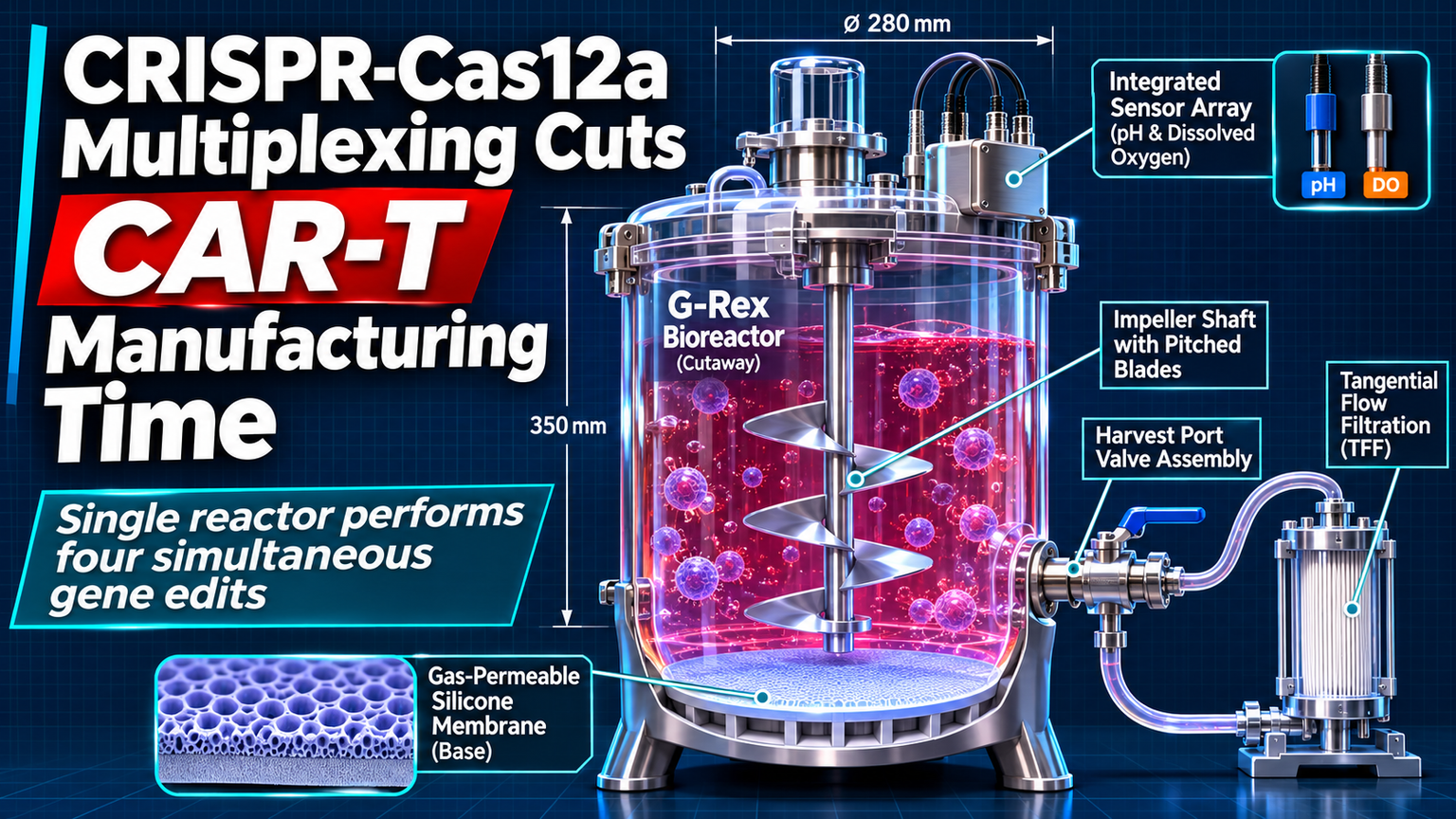
Unlike Cas9, Cas12a (Cpf1) processes its own crRNA array. A single transcript yields multiple mature guides, enabling true multiplexing from one vector. Teams at Beam Therapeutics and academic partners demonstrated simultaneous 4-plex editing—TRAC, B2M, PDCD1, and a safety switch locus—in primary human T cells with >80% quad-allelic knockout efficiency and <0.5% translocation frequency.
"We went from a 14-day editing workflow to a 3-day electroporation-to-QC release. That’s not incremental; it changes the facility footprint.
— Dr. Elena Ruiz, VP Process Development, Beam Therapeutics
Process Integration: From Electroporation to Bioreactor
The time savings compound downstream. Edited cells enter G-Rex or stirred-tank bioreactors at Day 3 instead of Day 14, cutting media consumption 60% and reducing bioreactor occupancy from two runs/month to six. Automation platforms (e.g., Lonza Cocoon, Miltenyi CliniMACS Prodigy) now accept Day-3 edited cells directly into closed expansion modules, eliminating open-handling steps that drive contamination risk and regulatory scrutiny.
| Metric | Sequential Cas9 (Legacy) | Multiplex Cas12a (New) |
|---|---|---|
| Editing rounds | 3 sequential | 1 multiplex |
| Total process days | 21–28 | 10–12 |
| Bioreactor starts/month | 2 | 6 |
| Media cost/dose | $18K–$22K | $7K–$9K |
| Translocation rate | 1.2%–2.5% | <0.5% |
💡
TipValidate guide arrays in primary donor lots early. Cas12a crRNA processing efficiency varies 2–3x across donors; a pilot screen of 5–10 donors prevents late-stage yield surprises.
Regulatory and Safety Implications
FDA’s CBER has signaled comfort with multiplex editing if off-target profiling uses GUIDE-seq or DISCOVER-seq at >500M read depth per guide. The single-vector approach simplifies CMC: one plasmid/RNA lot release, one integration site assay, one recombination assay. Sponsors should still budget for long-term clonal tracking—integration-free RNP delivery remains the gold standard for IND-enabling tox.
What’s Next: In Vivo Editing and Inducible Systems
The same multiplex architecture enables in vivo CAR-T generation—LNP-delivered Cas12a RNP + crRNA array editing endogenous T cells inside the patient. Early NHP data show 12% peripheral CAR+ T cells at Day 7 post-infusion. Pair this with a drug-inducible safety switch (e.g., iCasp9 or CD20) edited into the same locus, and you have a controllable, manufacturable, off-the-shelf pipeline that fits a single GMP suite.
✦
ℹ️
NoteAction item: Run a 3-donor pilot comparing your current sequential Cas9 workflow against a Cas12a 4-plex array. Measure Day-10 yield, translocation frequency, and media cost. If quad-knockout efficiency exceeds 70% with <1% translocations, build the tech transfer package for your CDMO.