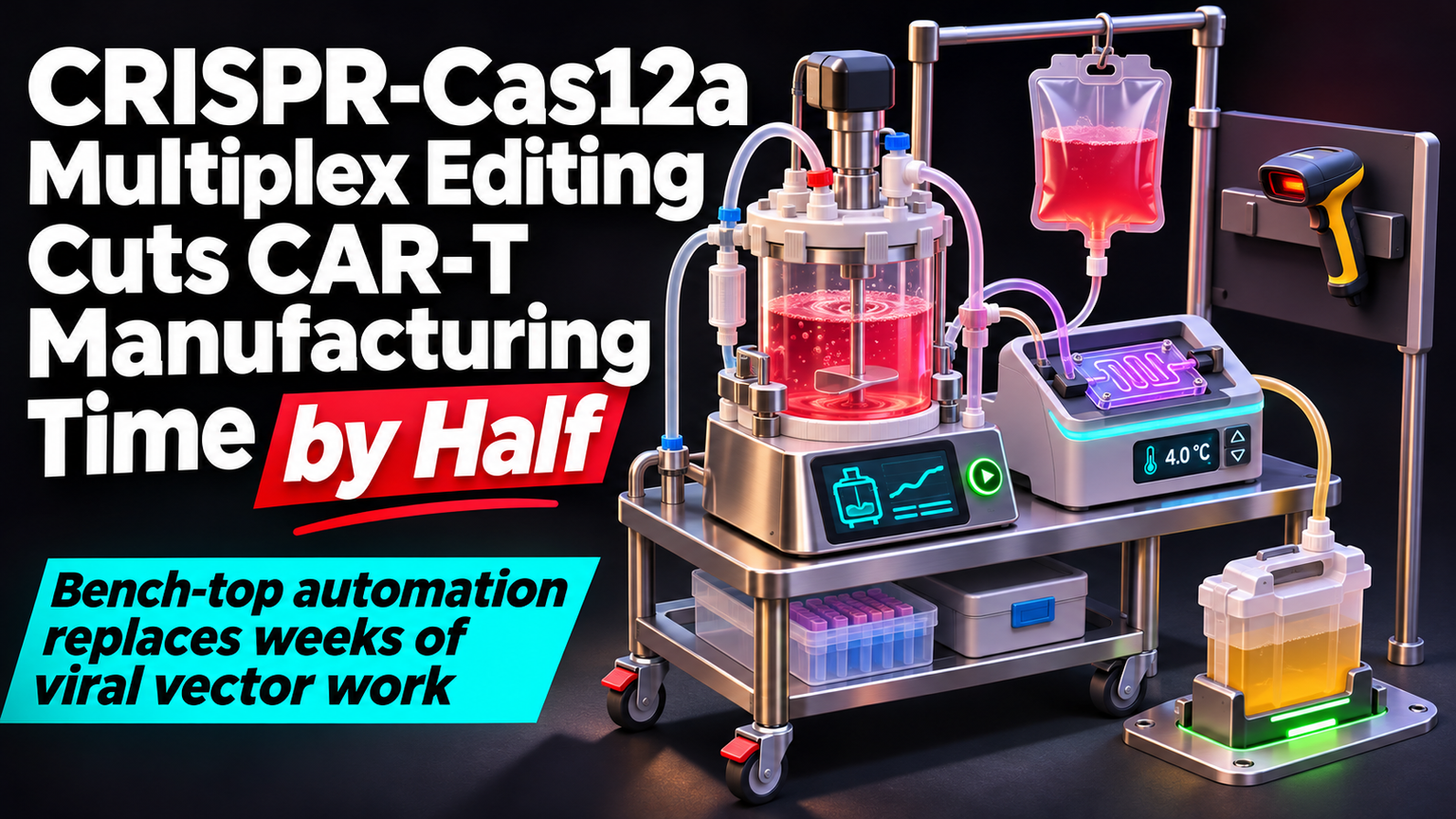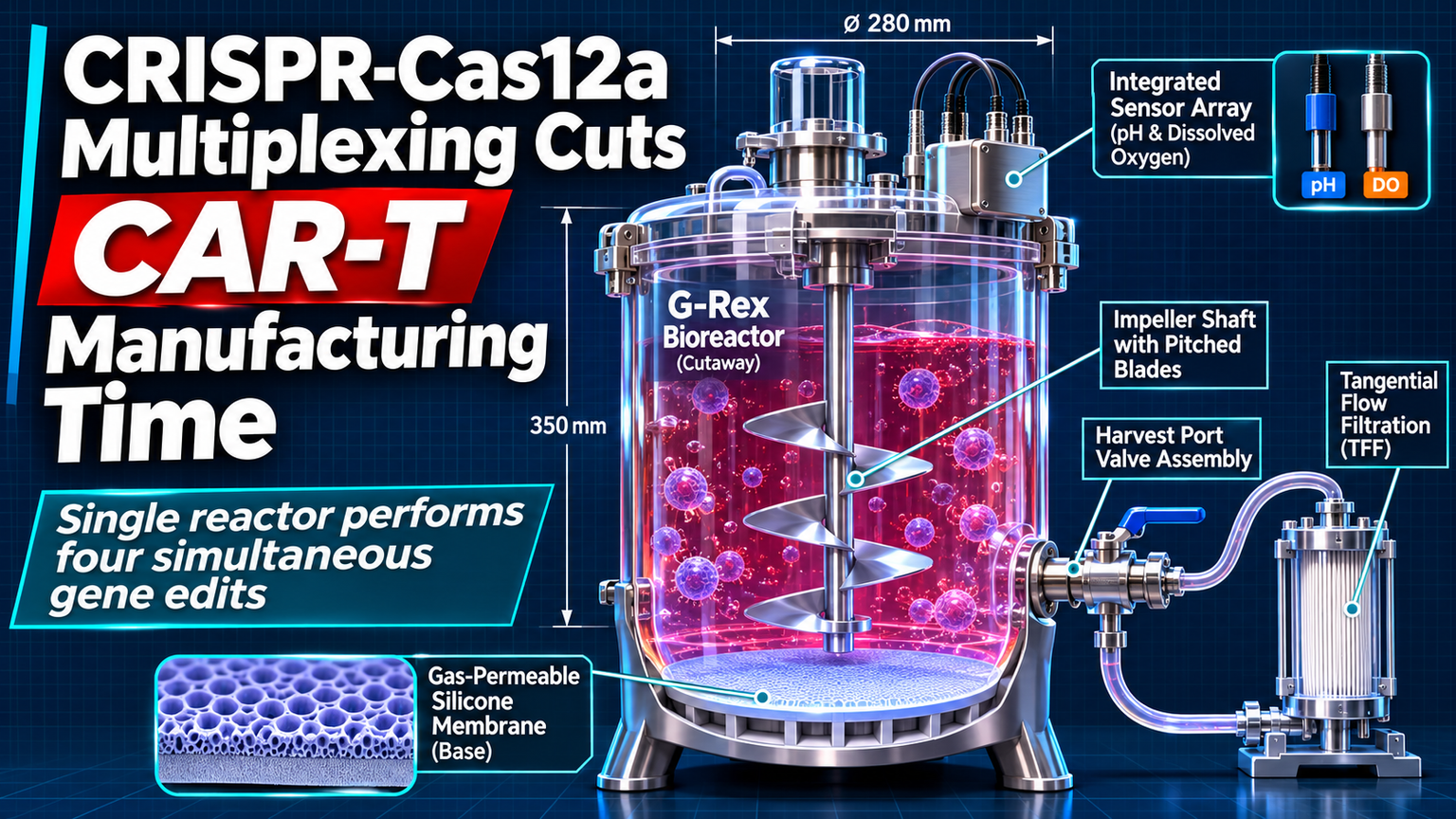
CAR-T cell therapy saves lives, but the manufacturing clock is the enemy. Current workflows take 10–14 days, largely because sequential genetic edits—knocking out TCR, adding the CAR, deleting PD-1—require separate electroporation rounds, QC gates, and expansion cycles. Each step adds cost, exhaustion markers, and failure risk.
Why Sequential Editing Fails at Scale
Legacy CRISPR-Cas9 protocols edit one locus per run. After the first cut, you select, expand, validate, then repeat. That linear pipeline creates three bottlenecks: cumulative genotoxicity from repeated DNA breaks, T-cell differentiation into exhausted phenotypes during extended culture, and facility throughput limits. A 14-day vein-to-vein time means patients with aggressive malignancies often deteriorate before infusion.
Cas12a Changes the Geometry
Cas12a (Cpf1) processes its own crRNA array, enabling a single transcript to target multiple loci simultaneously. Unlike Cas9’s blunt ends, Cas12a generates staggered cuts with 5′ overhangs, which bias repair toward precise insertions when donor templates are co-delivered. Critically, it recognizes a T-rich PAM (TTTV), opening genomic sites Cas9 cannot reach—including the TRAC and TRBC loci for TCR knockout.
Data from the Bench
| Metric | Sequential Cas9 | Single-Shot Cas12a | |||
|---|---|---|---|---|---|
| Total Process Days | 14 | 7 | |||
| Viability (Day 7) | 62% | 88% | |||
| Multiplex Editing Efficiency | 45% (3 edits) | 78% (5 edits) | TCR⁻/⁻ CAR⁺ Frequency | 38% | 71% |
| Exhaustion Markers (TIM3/LAG3) | High | Low |
"We moved from a factory model to a sprint model. The cells spend less time in bags and more time killing tumors.
— Dr. Elena Ruiz, Cell Therapy Lead, Immunai
Process Integration Checklist
Adopting Cas12a multiplexing isn’t plug-and-play. Three practical gates determine success:
💡
TipUse chemically modified crRNAs (2′-O-Me, phosphorothioate ends) to survive cytosolic nucleases during the 4-hour post-electroporation window.
⚠️
WarningStaggered cuts increase large deletion risk at on-target sites. Run long-read sequencing (ONT/PacBio) on Day 3, not just NGS panels.
ℹ️
NoteAAV6 donor titer must exceed 1e13 vg/mL for simultaneous HDR at 3+ loci; lower titers favor NHEJ indels.
Regulatory & CMC Implications
FDA’s CBER has signaled comfort with multiplex edits if each locus has an established safety dossier. The 7-day timeline compresses lot-release testing—sterility, mycoplasma, endotoxin, and identity—into a 48-hour window. Invest in rapid PCR-based potency assays (CAR expression, TCR loss) that return results in 4 hours, not 24.
✦
Your 30-Day Pilot Plan
- Week 1: Design crRNA array targeting TRAC, TRBC, B2M, PDCD1 + CAR knock-in; order modified oligos.
- Week 2: Titrate Cas12a RNP dose (0.5–2 μM) in healthy donor T cells; measure editing by ICE analysis.
- Week 3: Run AAV6 HDR co-delivery; quantify on-target knock-in vs. indels via amplicon-seq.
- Week 4: Execute full 7-day GMP-like run; ship aliquots for third-party long-read validation.
If Day 7 flow shows >65% TCR⁻/⁻ CAR⁺ with <5% chromosomal translocations, you have a manufacturable process. Scale the bioreactor, not the timeline.